Legal software
Software for law firms: conflicts, litigation, deals, billing, marketing and trademark work. All clients, matters and people in the demos are invented.
Case study 01 · Full-function law firm software
Conflion
Full-function software for running a law firm, built on a conflicts check and new-matter intake. One system on the firm's own server now covers matters and docketing, documents, time and billing, firm accounting links, people and CLE, client relationships, legal holds, the general counsel's office, IT and facilities, and a firm-wide AI layer that suggests while a person decides.
Try the demoWatch Newton's full-process pitchFollow one matter, start to finishConflion Information SheetPrototype code
- Areas of the firm covered
- 12
- Firm roles modelled
- 7
- Passing tests (237 test files)
- 3,554
- Click-through checks in a real browser
- 360
- Synthetic parties benchmarked
- 3,000,000
- Competitors researched
- 14+
From a conflicts desk to the whole firm
Conflion began as conflicts and intake, and that is still where every matter starts. It now runs the rest of the firm on the same clients, matters and people, with one set of permissions applied on the server and one firm inbox that lists every decision waiting on each person, with a short morning brief for their role. The firm keeps its systems of record (billing, ledger, HR, document and device systems) and Conflion connects them.
Matters and docketing
A matter workspace with stages, tasks and a record timeline. Court deadlines counted from the rules for California, New York, Texas, Florida, Illinois, Nevada and federal appeals, each step citing its rule, with court notices read into the docket for a clerk to confirm and two-way sync with Outlook or Google calendars.
Documents
Matter folders made at opening, check-out and check-in with version comments, a profile on every document, email filed to a matter from Outlook, and saved searches for each person.
Time, billing and accounting links
Time entry with suggested task codes, pre-bills, bill review, invoices, LEDES exports, collections and a pricing desk. Approved journal entries post to the firm's own ledger in QuickBooks Online, Xero or Sage Intacct, with vendor bills, a bank feed, payroll imports, a cash forecast and partner draws.
People and CLE
One record per person from the HR export, bar admissions and CLE reminders, time away with cover, reviews and feedback, associate development, recruiting, joiners and leavers, and a book test drive for lateral hires before any offer.
Client relationships
Contacts and every conversation with them, key clients with account plans, feedback at matter close, events, mailing lists with consent, panels and RFPs, referral sources and a client portal. A contact is never mixed into the conflicts records.
Risk and the general counsel's office
Claims and incidents against the firm, insurance renewals, ownership due diligence on clients, a risk register and a promise ledger. Legal holds with acknowledgements and reminders, and a file destruction review that a hold always stops.
The office
An IT help desk, a register of the devices and software each person holds, meeting rooms, visitors, post and couriers, and off-site boxes tied to their matters. A leaver's laptop sits on the same checklist as their files and holds.
Knowledge and practice support
"Who has done this" from the firm's own matters, a clause bank with fallback positions and review dates, precedents, closing sets and signature packets (Conflion never signs), privilege logs and productions, and a staffing board.
Ask Newton and the AI tools
One question box for the firm whose answers link to the records behind them, and tools that watch the work: matter pulse, an obligation calendar, an early case read, a client risk radar on public sources, bench notes and rule change watch. Each shows its sources, and a person decides.
The problem
Before a firm takes a matter, it must check every party against everyone it has represented or opposed. Mid-size firms usually search their billing system letter for letter, so they miss parent companies, former names, nicknames and misspellings. Intake is a web form nobody connects to the search, and the enterprise tools are quote-only and installed by consultants.
The people involved have different needs. An associate submits the request, a conflicts analyst reviews the hits, practice leaders and general counsel approve, and finance opens the matter. Conflion gives each of seven roles its own view.
How the matching works
- Names are normalized: corporate suffixes stripped, abbreviations expanded, initials collapsed so "A.B.C. Holdings" finds "ABC Holdings".
- Three scorers combine: a phonetic key (Smith and Smyth), Jaro-Winkler for typos, and trigram overlap for spacing. Rare words weigh more than common ones.
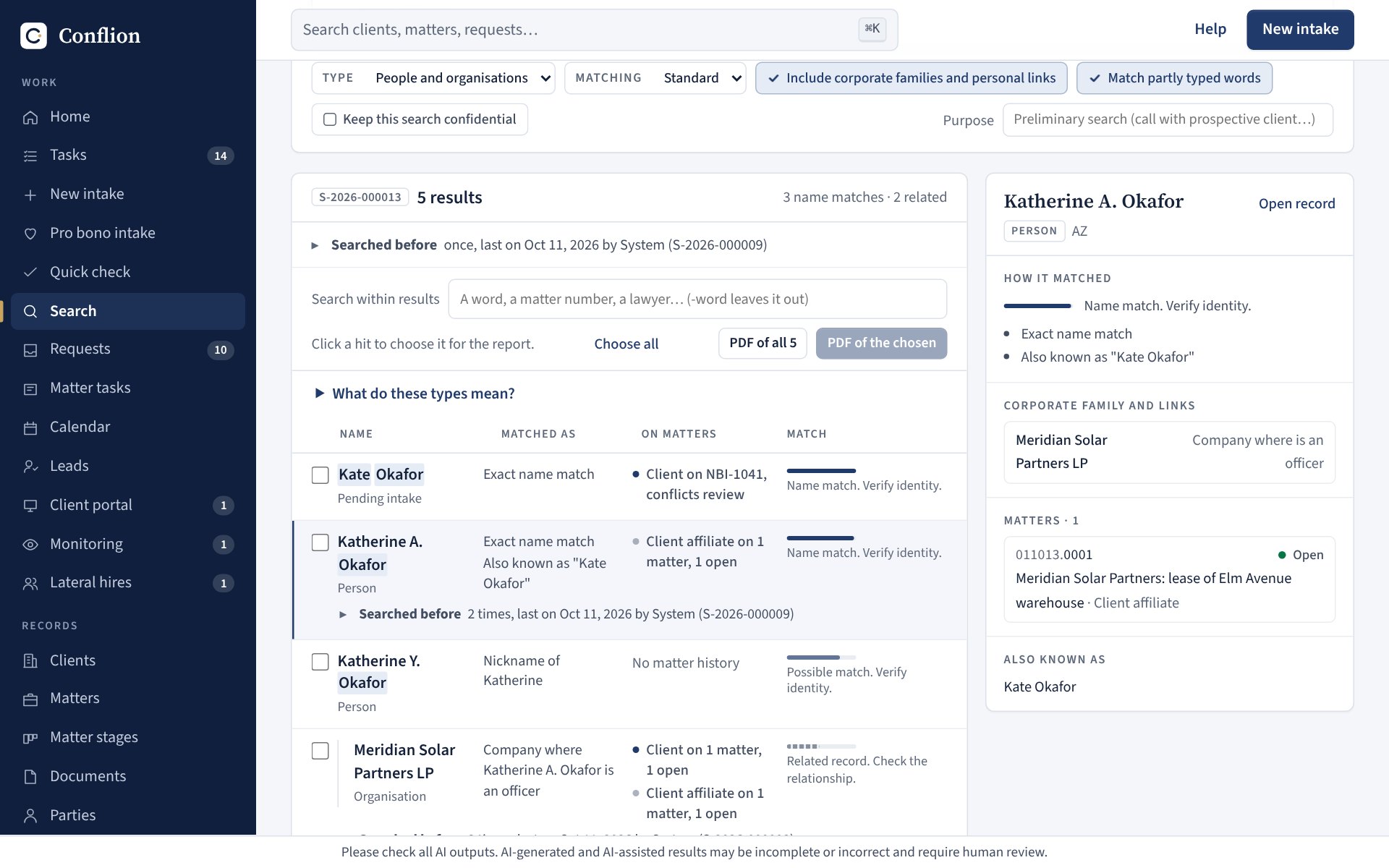
- People match on surname first, then first name with 30+ nickname pairs (Kate and Katherine), aliases and former names.
- Strong matches expand two hops through corporate families and one hop through personal links such as spouses and officers.
Decisions that come from knowing the work
Risk follows the relationship
A name match alone means little. Being adverse to a current client on an open matter is high risk; a closed matter is medium; a match only through a personal link is capped below high. Related parties with no matter history are dropped as noise.
Rules are built in
Former clients point to Rule 1.9, prospective clients to Rule 1.18, lawyer relationships to California Rule 1.7(b) and (c) disclosures. Lateral hires get the 1.10, 1.11 and 1.12 analysis, and engagement letters check the California fee-agreement statutes.
Lawyers decide, software suggests
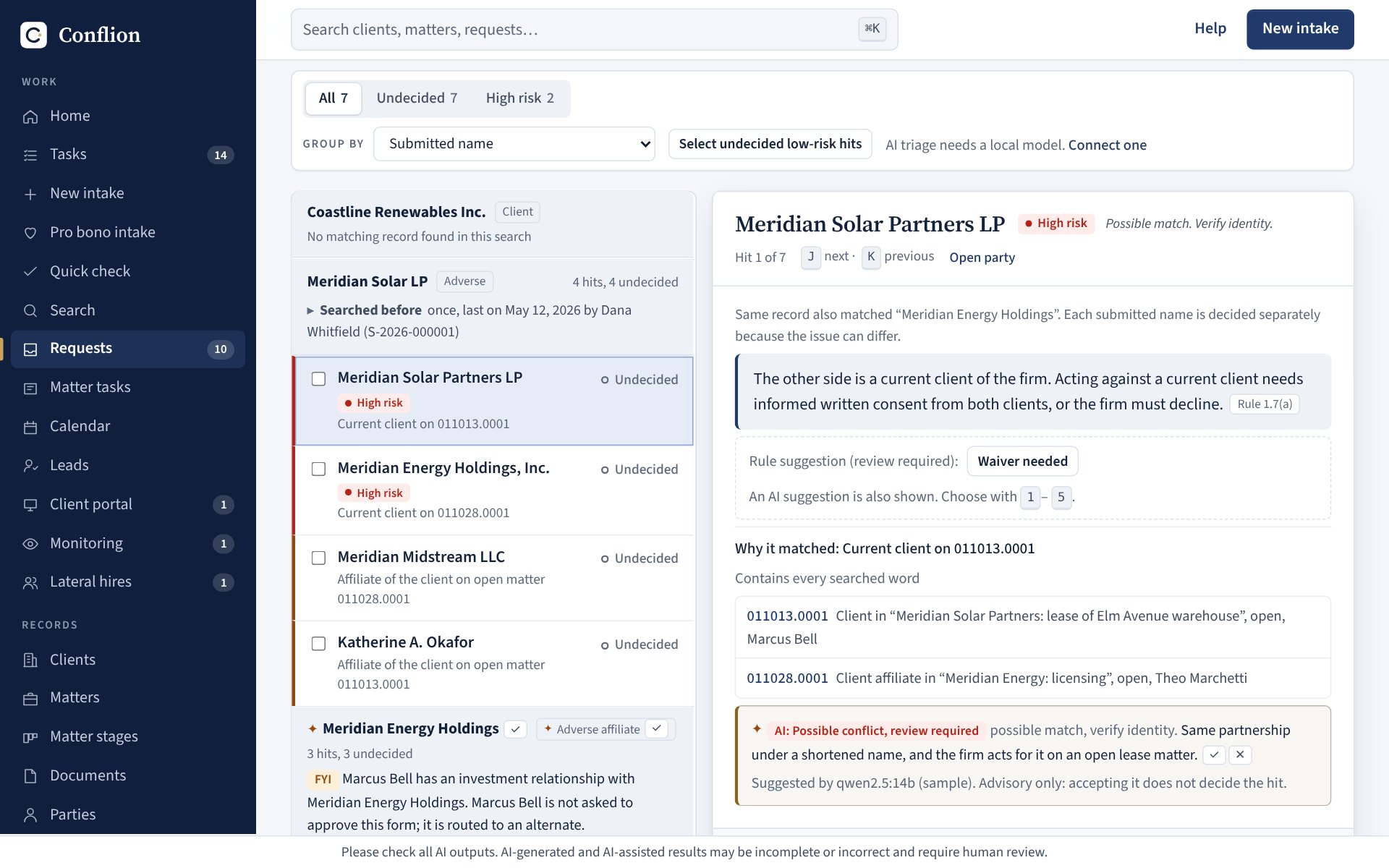
The local AI pre-sorts hits and drafts memos, but every AI-filled field carries a mark until a person confirms it. Restricted and walled data never reaches the model, and accepting a suggestion never decides a hit.
Least privilege by role
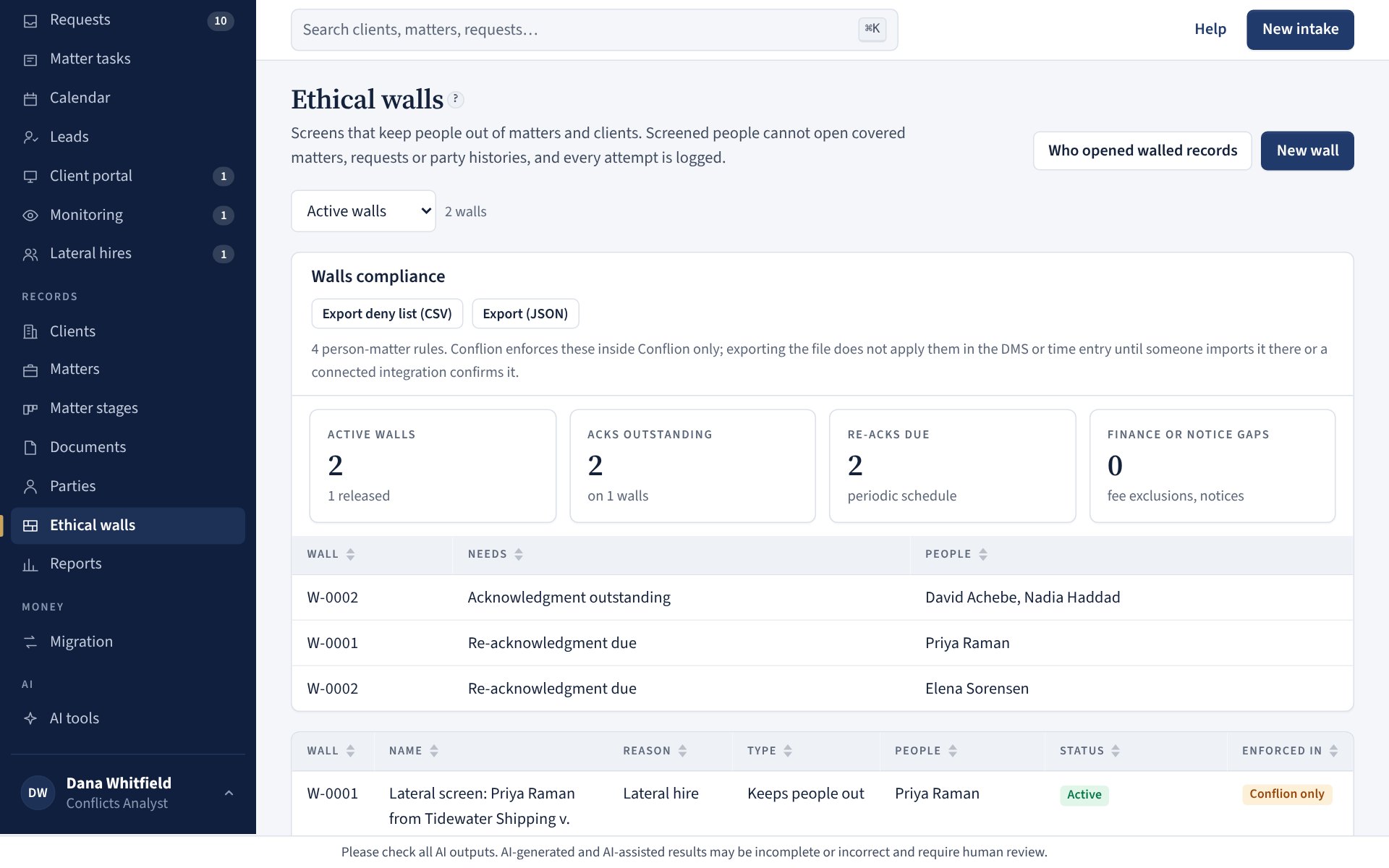
Approvers see a summary and a sign-off. Requesters see no firm records while they type. Walls are enforced in what the server sends each user, and every blocked attempt is logged.
An audit trail that proves itself
The log is append-only with a hash chain and a "Chain intact" check, and database triggers refuse edits. Matters cannot close until the final bill is issued and trust is at zero.
Speed for the analyst
J and K move between hits, 1 to 5 record a decision, Enter accepts the suggestion, and earlier decisions on the same party appear inline.
Under the hood: scale, outside data and a private model
Conflion now has about 279,000 lines of TypeScript (about 223,000 of source and 56,000 of tests), 3,554 passing tests across 237 test files, and 360 click-through checks that drive the real app in a browser before each batch of changes is merged. It runs two ways from the same code: a browser-only demo on fictional data, or a firm server with its own database, single sign-on, email and an AI model on the firm's own hardware.
Built for a firm with millions of names
Row-level storage, incremental sync and server-side search replaced loading everything into the browser. A repeatable benchmark on synthetic firms goes up to 3,000,000 parties, with a written account of what limited a large firm and what changed.
Outside entity data, watched nightly
A party can be linked to its public-register record: legal-entity data and SEC filings, including subsidiaries read from the latest annual report. A person chooses which names and parents or subsidiaries to add. A nightly job lists what changed for a person to accept or set aside, and cleared requests are flagged for another look.
Search that shows its coverage
Every search gets a number and shows what it covered. An empty or missing source is never shown as clearance, hits carry plain labels such as "likely same entity" instead of scores, and a no-match result is neutral, not green.
Faster hit review
A compact hit list with sticky party headers, identity review kept apart from the conflict assessment, and follow-ups tracked until resolved. The suggested order is learned locally from the firm's own past decisions, shows its factors and counts, is off by default, and never hides a hit or records a decision. An offline evaluation of the ranking is written up in the repo.
Confidentiality and lateral hires
Confidential matters are searched in batch without being revealed: the user is told there is a confidential match and nothing more. Lateral hires get a pre-start checklist with distinct pending, blocked, not-applicable and complete states, each backed by evidence.
Compliance records
Required documents per request, a summary of each conflict, and tracking for business-associate agreements, joint-representation consents and founder acknowledgements.
Measured speed
- Name search (median): 77 ms to 1.3 ms at 50,000 parties; 535 ms to 5.3 ms at 250,000.
- Submitting an intake: 1.5 s to 37 ms at 50,000; 8.0 s to 20 ms at 250,000.
- After a colleague's change, a browser downloads 1 KB instead of reloading 200 KB.
- Server memory at 250,000 parties: 5.4 GB down to 1.8 GB.
All figures come from a benchmark script run on synthetic firms.
A model that stays on the firm's hardware
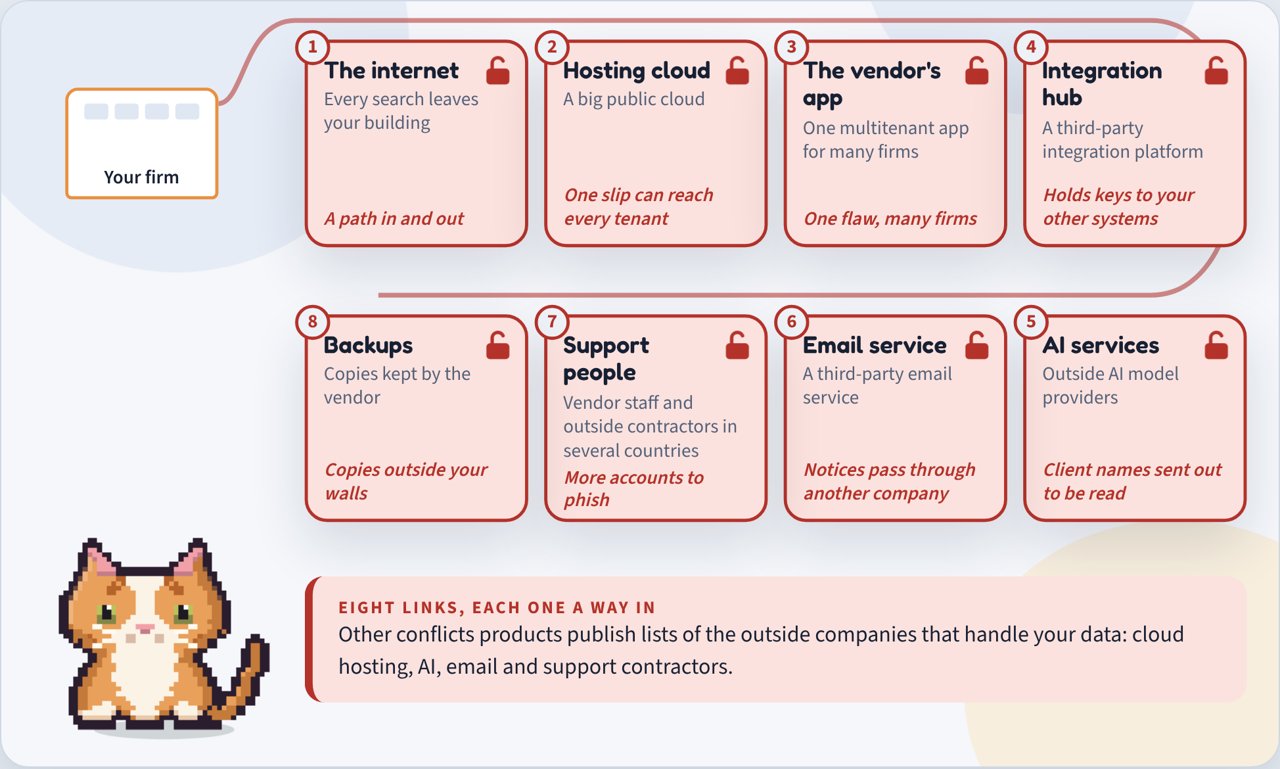
The AI runs through Ollama or any OpenAI-compatible local server, so client names never leave the building. It triages hits with a short reason, finds parties in a matter description or pasted email (any name that is not in the text is discarded), drafts a conflicts memo from the recorded decisions only, and suggests column mapping for imports. Every use is written to the audit log with the model name. The ranking model is a separate local statistical fit that uses no AI provider.
Teaching and testing inside the app
- Role-based walkthroughs (open a matter, prepare a request, approve, clear, get your firm live) that point at things but never click, submit or decide.
- A first-week checklist that ticks itself off from what the person actually does, with tests that limited roles are never shown a step for a page they can't open.
- A test environment on a fictional firm, marked by a striped banner on every page. It never writes to live data, sends email or calls an outside AI provider.
Support without sharing firm data
An administrator builds a support bundle of counts, settings switches, versions and error messages with names replaced by placeholders, reads it, then saves it. Nothing is sent automatically, and saving is written to the audit trail. To see a problem happen, support uses a test firm of made-up records at the same size and shape. The live app opens empty, with no sample data, and the desktop app ships for Windows, macOS and Linux with a first-run setup.
Taking it to market
- Research. 14+ competitors compared from public sources, and 21 gaps ranked.
- Pilot. Five firms over 90 days in four phases, measured on intake-to-cleared time, analyst hours per check and hits the old system missed.
It began as the Conflicts Desk prototype in Claude Code, with tests and CI, and grew into Conflion. I supplied the domain: how conflicts departments actually run, which rules apply, and where existing tools fall short. Claude built the search engine, the synthetic firm and every screen. It then helped research competitors, price the product, write the pilot pack and script and animate the pitch. From there I mapped every area of a firm against what Conflion covered and directed the build of each missing one, from docketing and documents to people, client relationships, the general counsel's office and the office itself, with each area's privacy rules set before its screens.
Case study 22 · Small-firm software
Conflion Small Firm
Conflicts checks and new matters for firms of 5 to 20 people: one home screen that says what to do next, one page to open a matter, and a name check anyone can run.
Conflion Small Firm
Conflicts checks and new matters for firms of 5 to 20 people: one home screen that says what to do next, one page to open a matter, and a name check anyone can run.
Take Newton's tourWatch the conflicts-only tourProspect demo (access code)
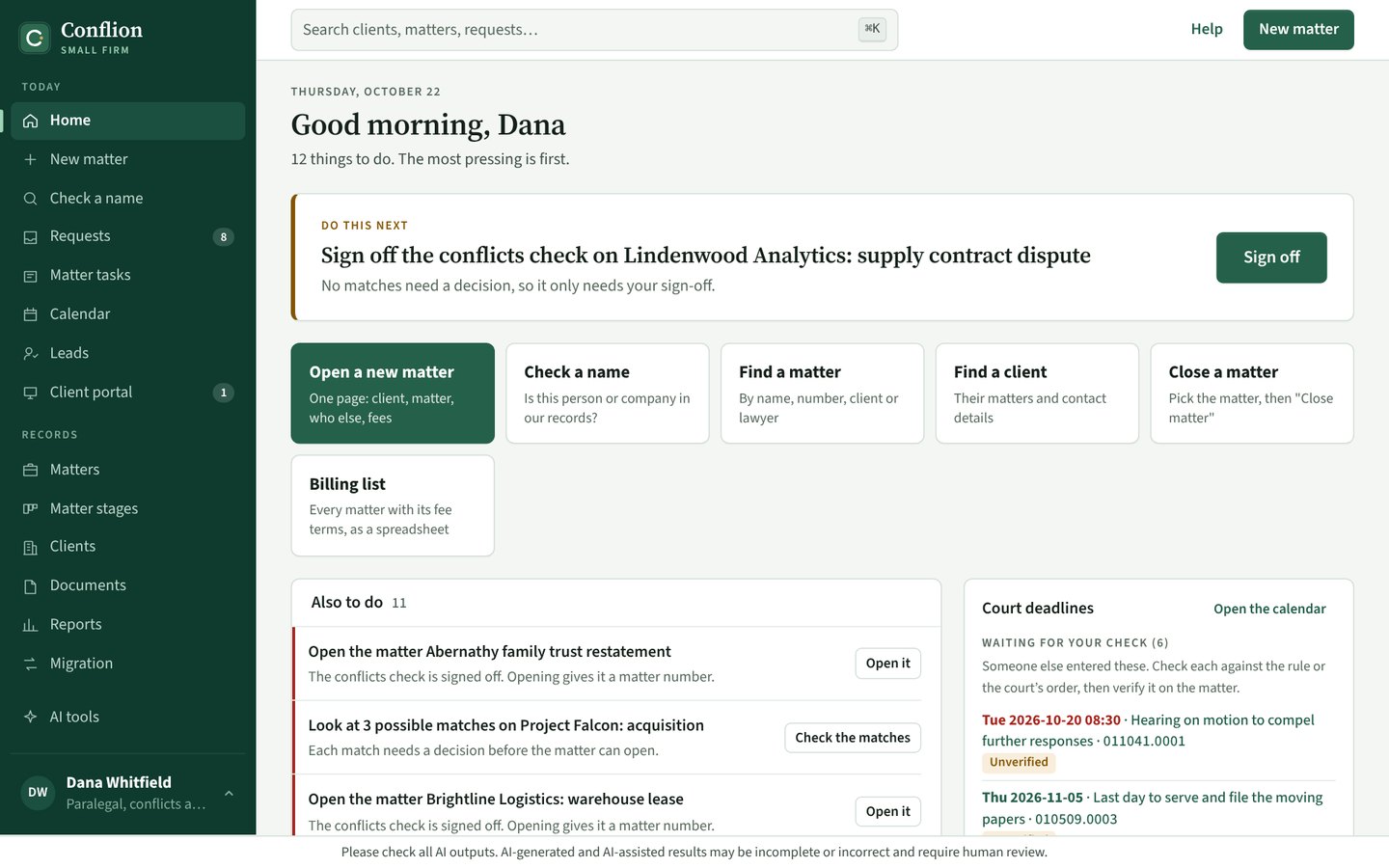
I set the brief: a small firm has no conflicts analyst, so the screens have to explain themselves. Claude built the edition, wrote both tours and animated them in HTML, CSS and JavaScript with a light and dark mode, and built the browser demo that prospects can open with an access code.
Companion to case study 01 · Legal software
VigilMark
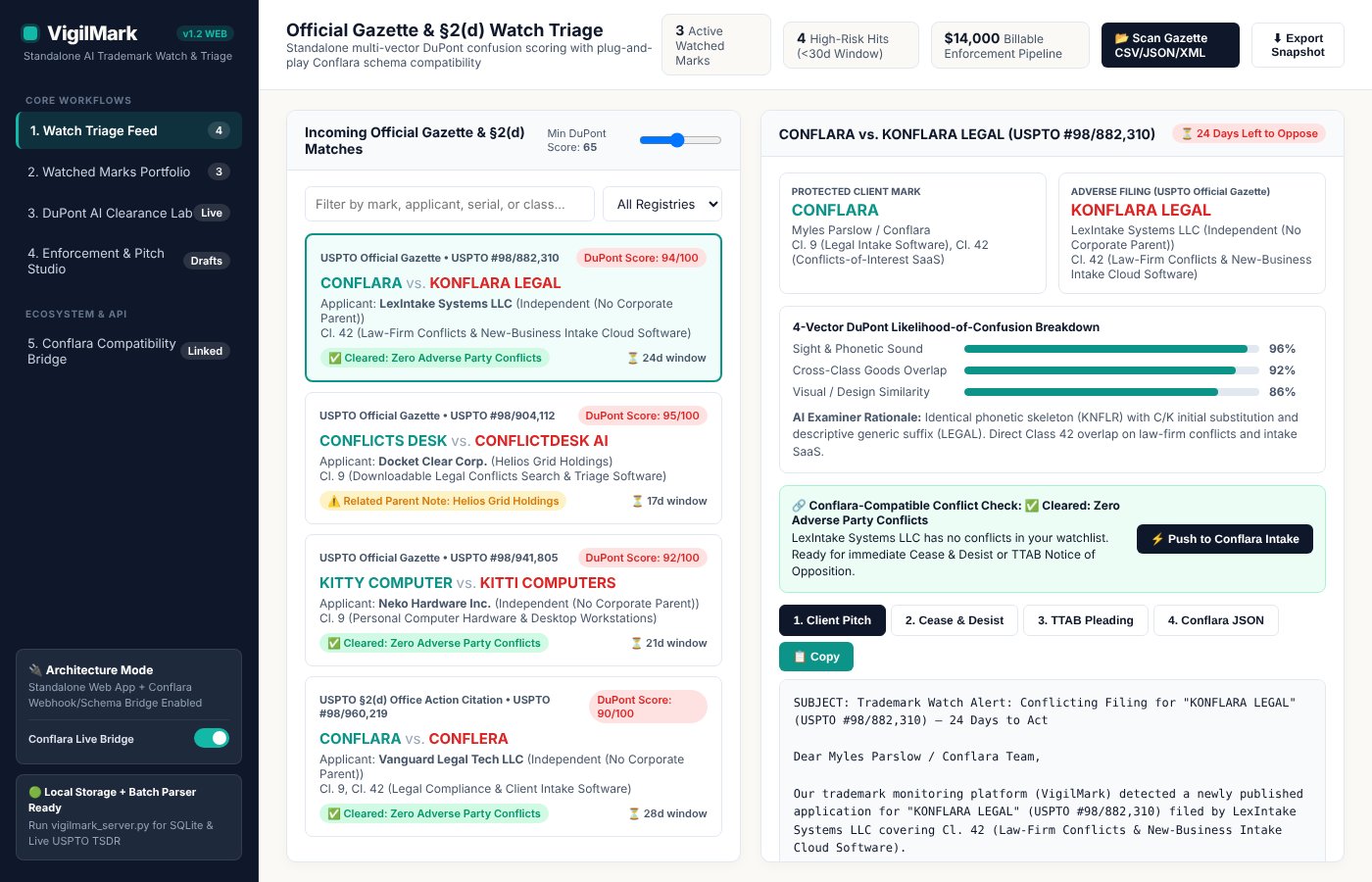
A trademark watch and triage desk for a conflicts-first law firm: it ranks new filings that look like a client's mark, checks whether the applicant is related to a firm client, and hands the hit to Conflion as an intake.
VigilMark
A trademark watch and triage desk for a conflicts-first law firm: it ranks new filings that look like a client's mark, checks whether the applicant is related to a firm client, and hands the hit to Conflion as an intake.
Screenshots below
The problem
Trademark watch services flag new filings, but someone still has to decide which hits matter, check whether the applicant is related to an existing firm client (opposing a client's subsidiary can be a conflict of interest), and turn the hit into an engagement before the 30-day opposition window closes. Those three steps usually sit in different tools and inboxes.
What it does
- Triage feed of incoming Official Gazette and §2(d) hits, ranked by score and days left, filterable by registry.
- Watched marks portfolio with classes, goods and services, registries and watch strategy.
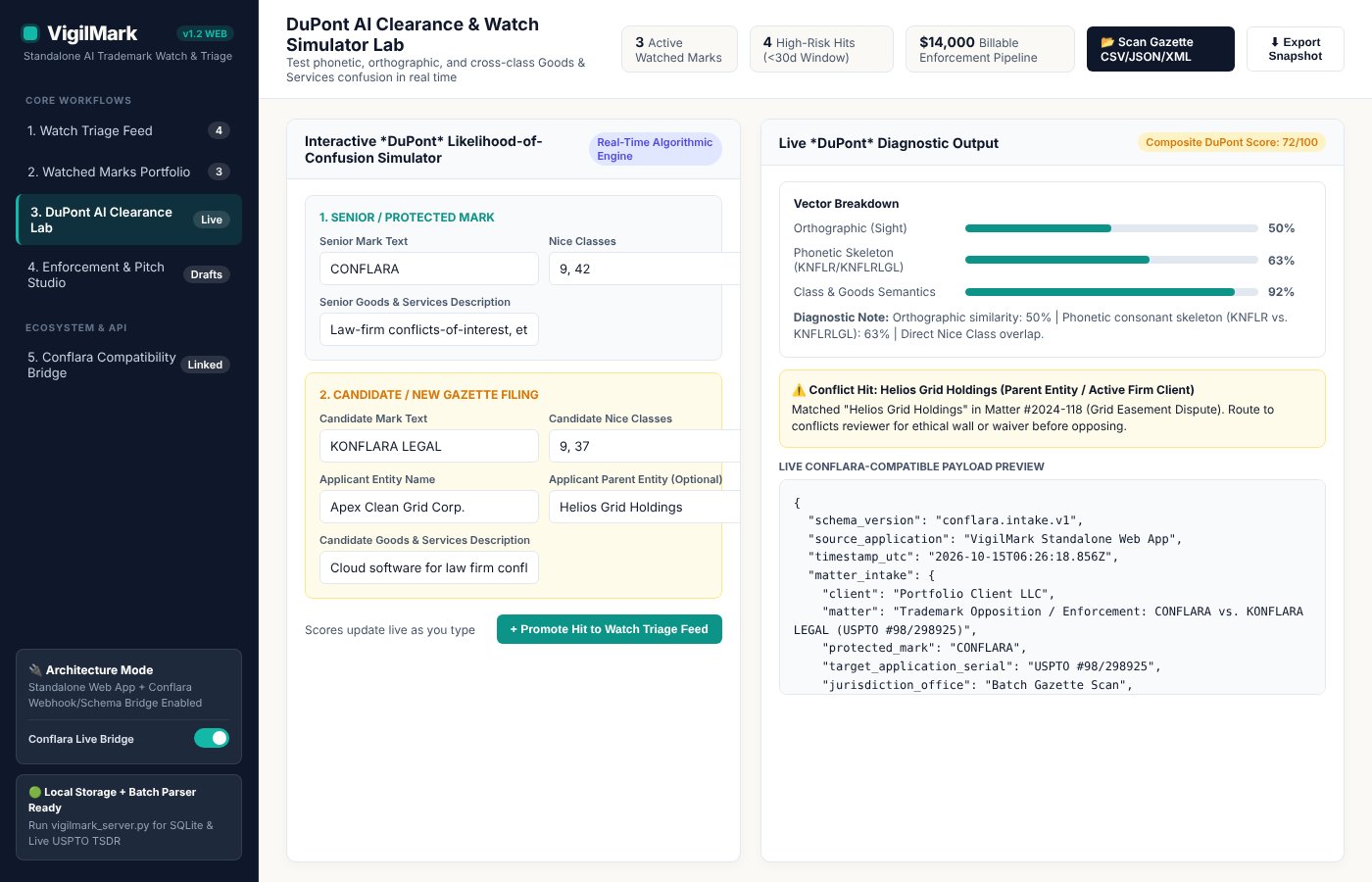
- Clearance lab: type two marks and see the scores update live.
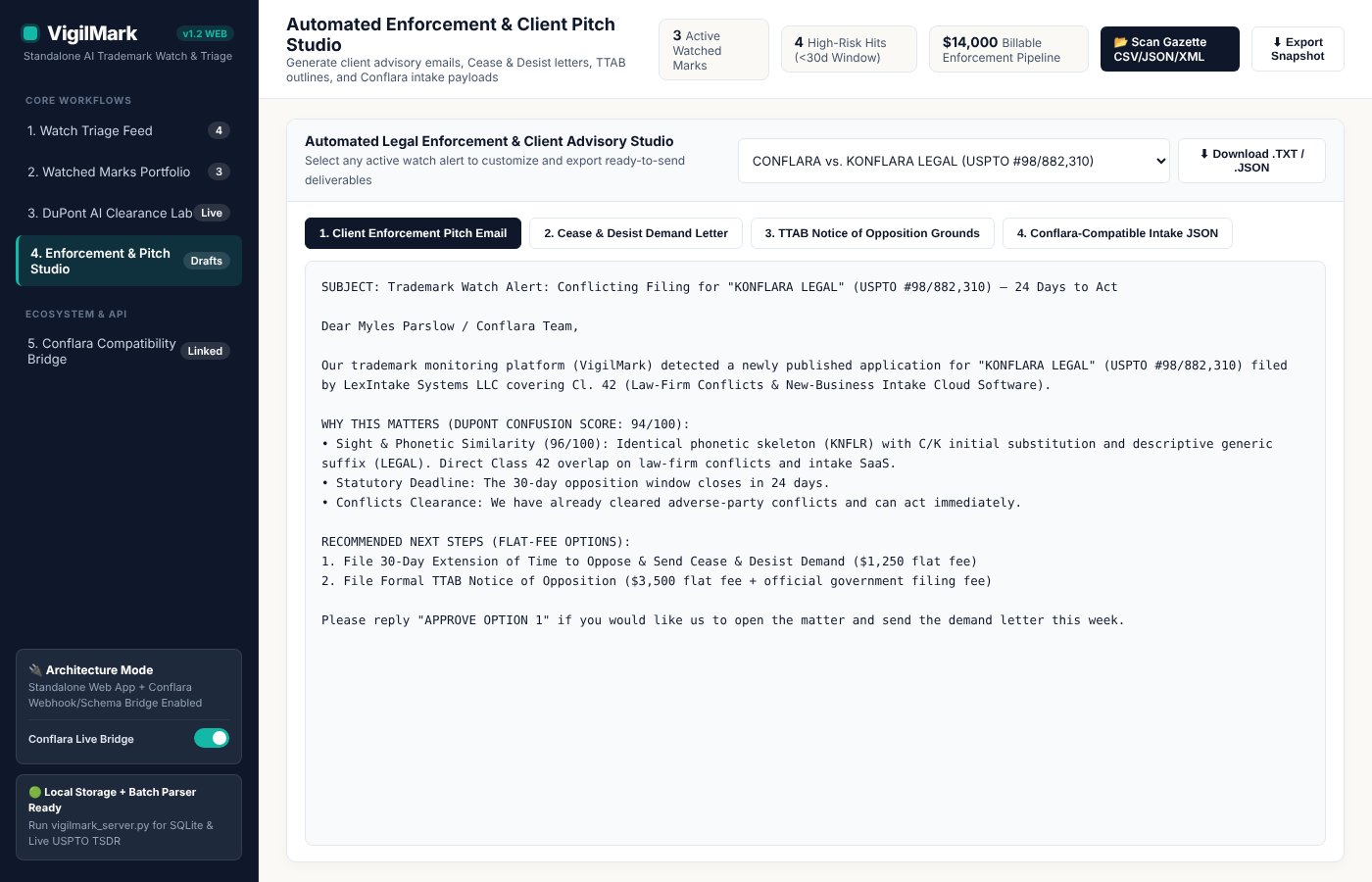
- Enforcement studio: from any hit, a client pitch email with flat-fee options, a cease and desist letter, notice-of-opposition grounds, and an intake file.
- Batch import of Gazette filings as CSV, JSON or XML, each scored against every watched mark.
How it connects to Conflion
A published contract
VigilMark defines a versioned schema, conflara.intake.v1, that maps a trademark hit onto Conflion's intake: client, matter, related parties and party roles such as parent entity, lead investor and adverse counterparty subsidiary.
Conflict check first
Before it recommends anything, VigilMark checks the applicant and its parent against a watchlist of firm clients and their corporate families, and marks the hit Cleared, Subsidiary review or Direct conflict, always flagged for human verification.
Loosely coupled
One click sends the hit, its scores and the conflict result into Conflion as a signed webhook. The two products share a versioned schema, not a database, so either can change inside without breaking the other. A toggle runs it standalone or in bridge mode.
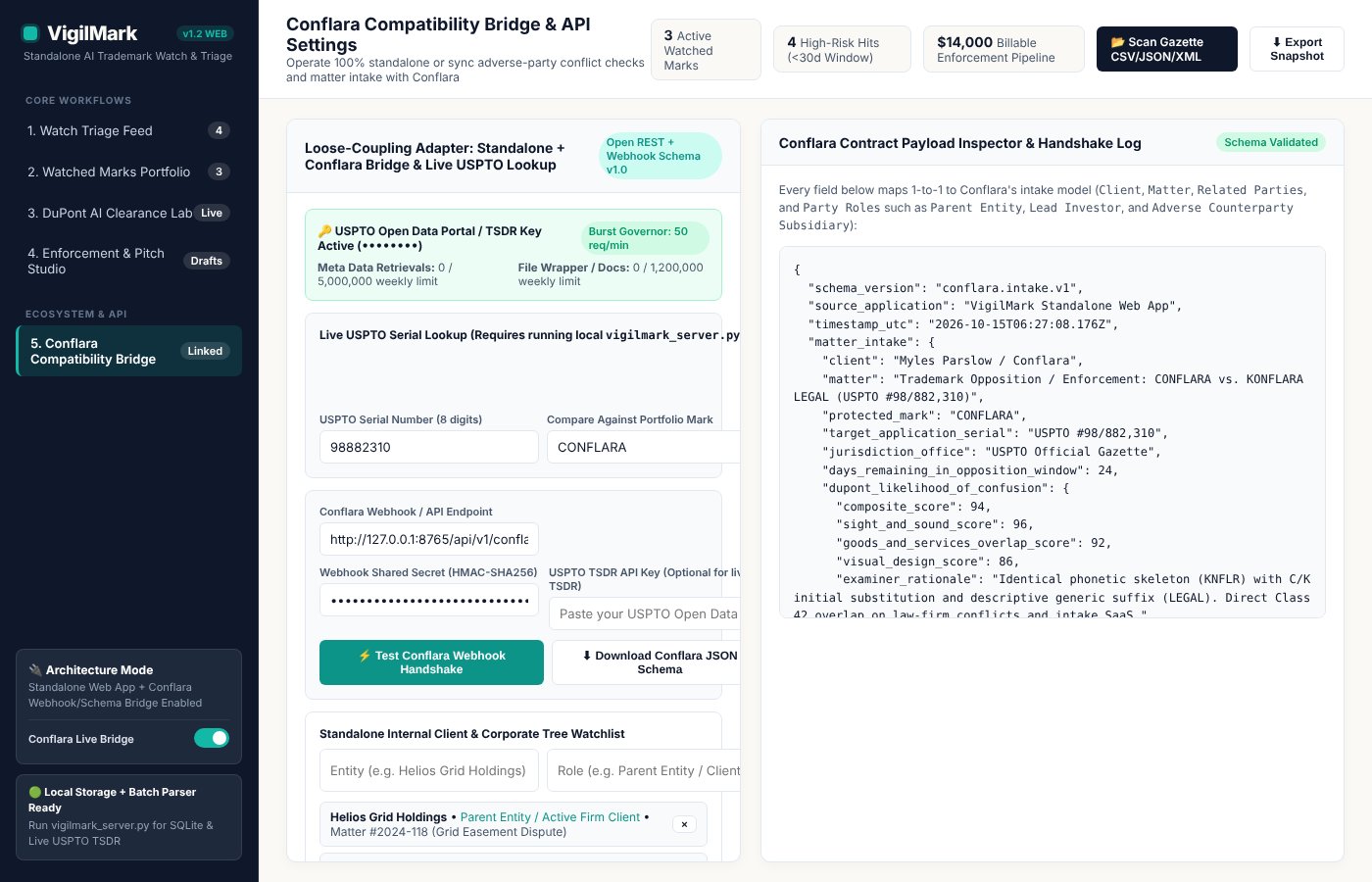
Scoring you can explain
There is no model call. Sight is an edit-distance similarity. Sound compares phonetic consonant skeletons, so CONFLARA and KONFLARA both reduce to the same letters. Those combine into a mark score, which is blended with a goods-and-services score built from exact class matches, coordinated class groups and shared description vocabulary. Every score comes with a written rationale, which matters for legal work. The app's own labels say "AI"; this is plain algorithmic scoring.
Built to run anywhere
- Standard-library Python backend with a local database, and a single-file web app that also works straight from disk.
- A native Mac wrapper that starts the server and opens the app in its own window.
- Live trademark lookups with rate-limit tracking when an API key is present, and a built-in sample index when it isn't.
Built with Google Gemini, which wrote the web app, the Python server, the Mac wrapper and the schema. I set the idea and the Conflion hand-off.
Case study 23 · Native Mac app · Legal AI strategy
Praxis
A strategy studio for the people deciding where a law firm should use AI. It maps every idea by where the demand came from and how much it changes the work, scores it with honest ranges, ranks the portfolio under different strategies, and carries the winners through pilots.
Praxis
A strategy studio for the people deciding where a law firm should use AI. It maps every idea by where the demand came from and how much it changes the work, scores it with honest ranges, ranks the portfolio under different strategies, and carries the winners through pilots.
Take the guided tourScreens from the running Mac app, with hypothetical demo records
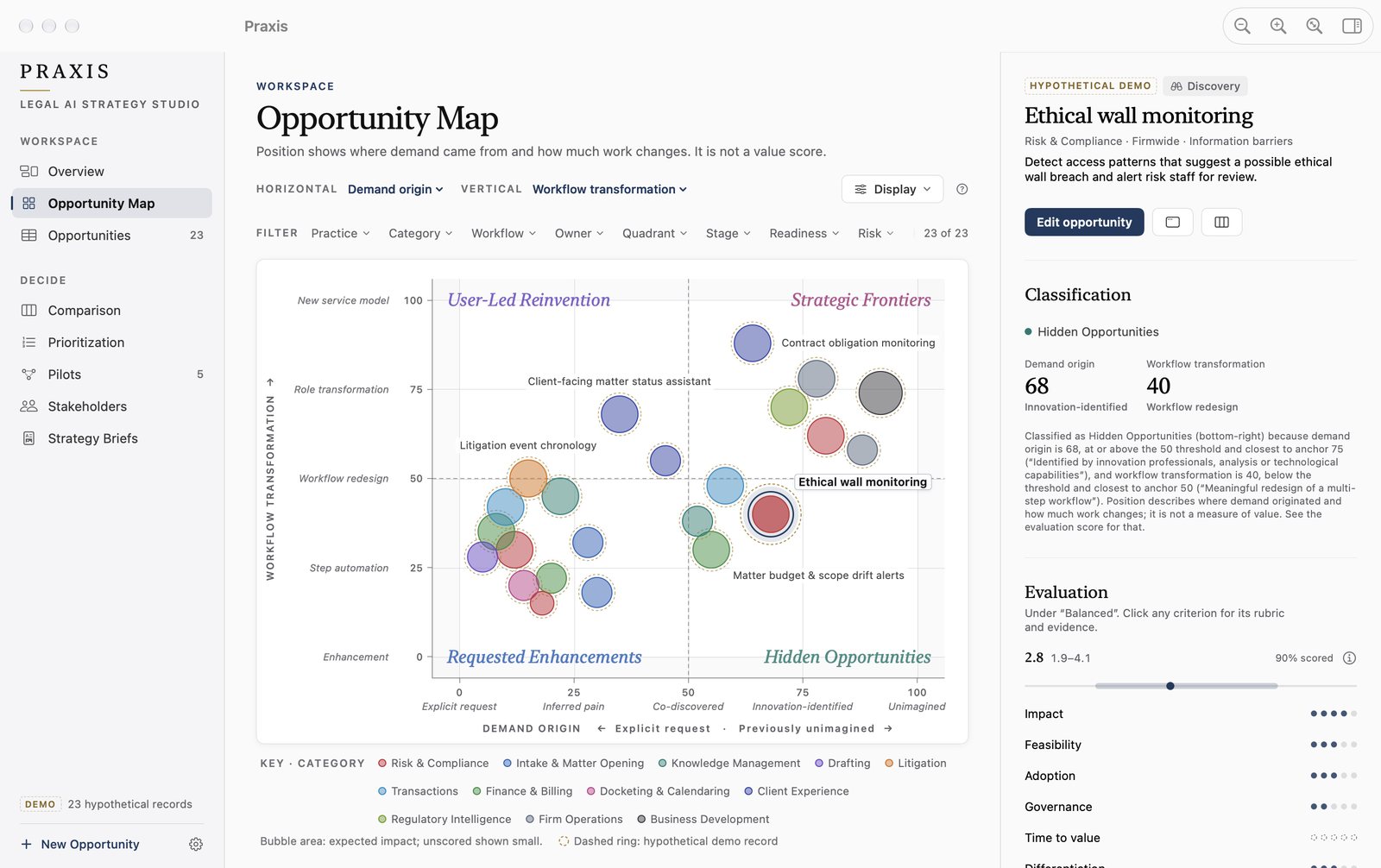
The problem
Every firm now has a list of AI ideas, from vendors, partners and its own innovation team. The list is usually ranked by enthusiasm. Ideas with no evidence look as good as proven ones, the loudest request wins, and nobody can explain afterward why one pilot was chosen over another.
What it does
- A portfolio briefing that opens with a sentence a managing partner can repeat, and rule-based insights that each show the rule behind them.
- Seven-criterion scoring with confidence ranges. A missing score is never treated as favorable, and thin evidence widens the range.
- Scenario rankings (balanced, quick wins, differentiation) that state their assumptions and show how each idea moves between them.
- Side-by-side comparison, a pilot board, a stakeholder map and editable strategy briefs that export to Markdown and PDF.
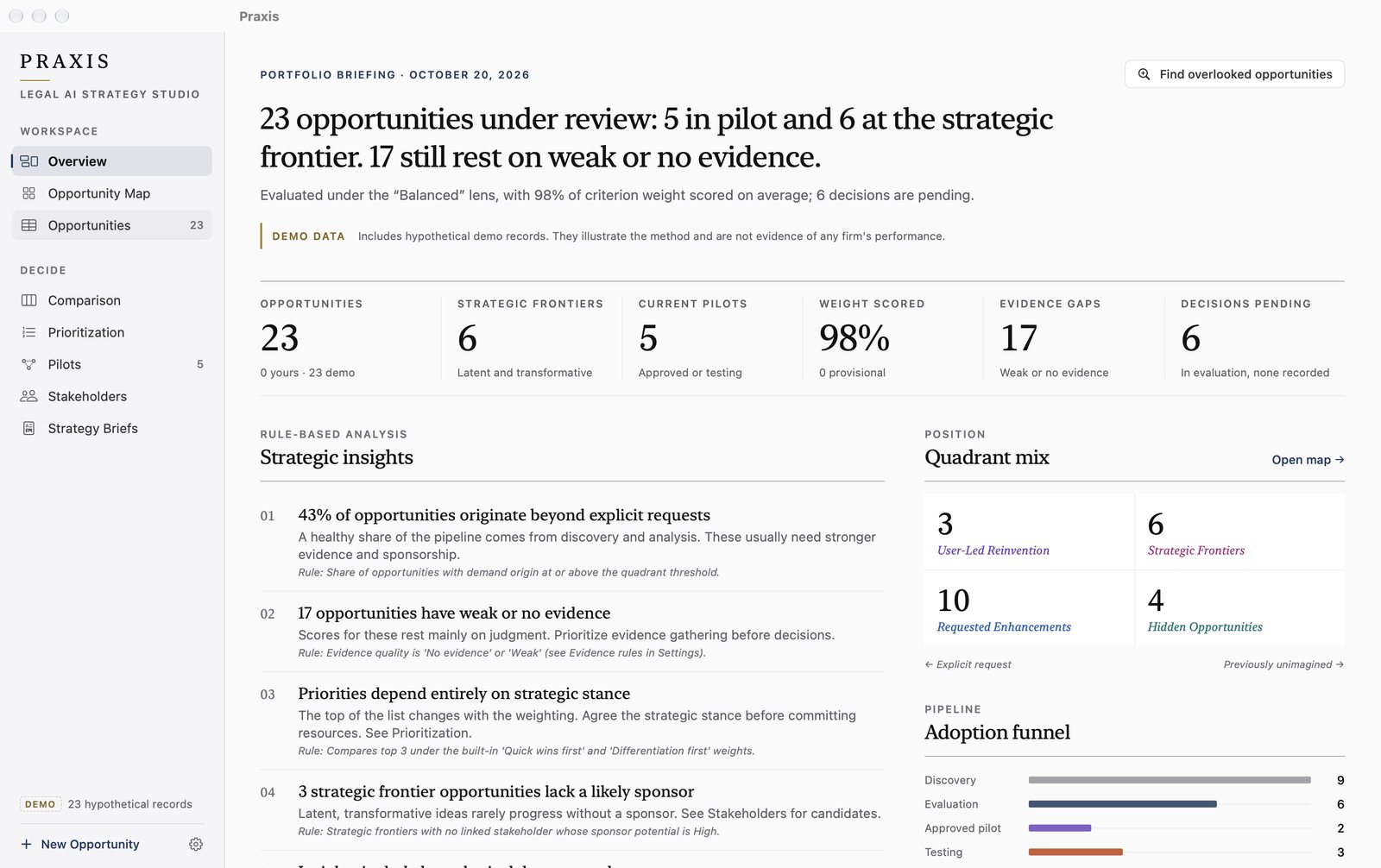
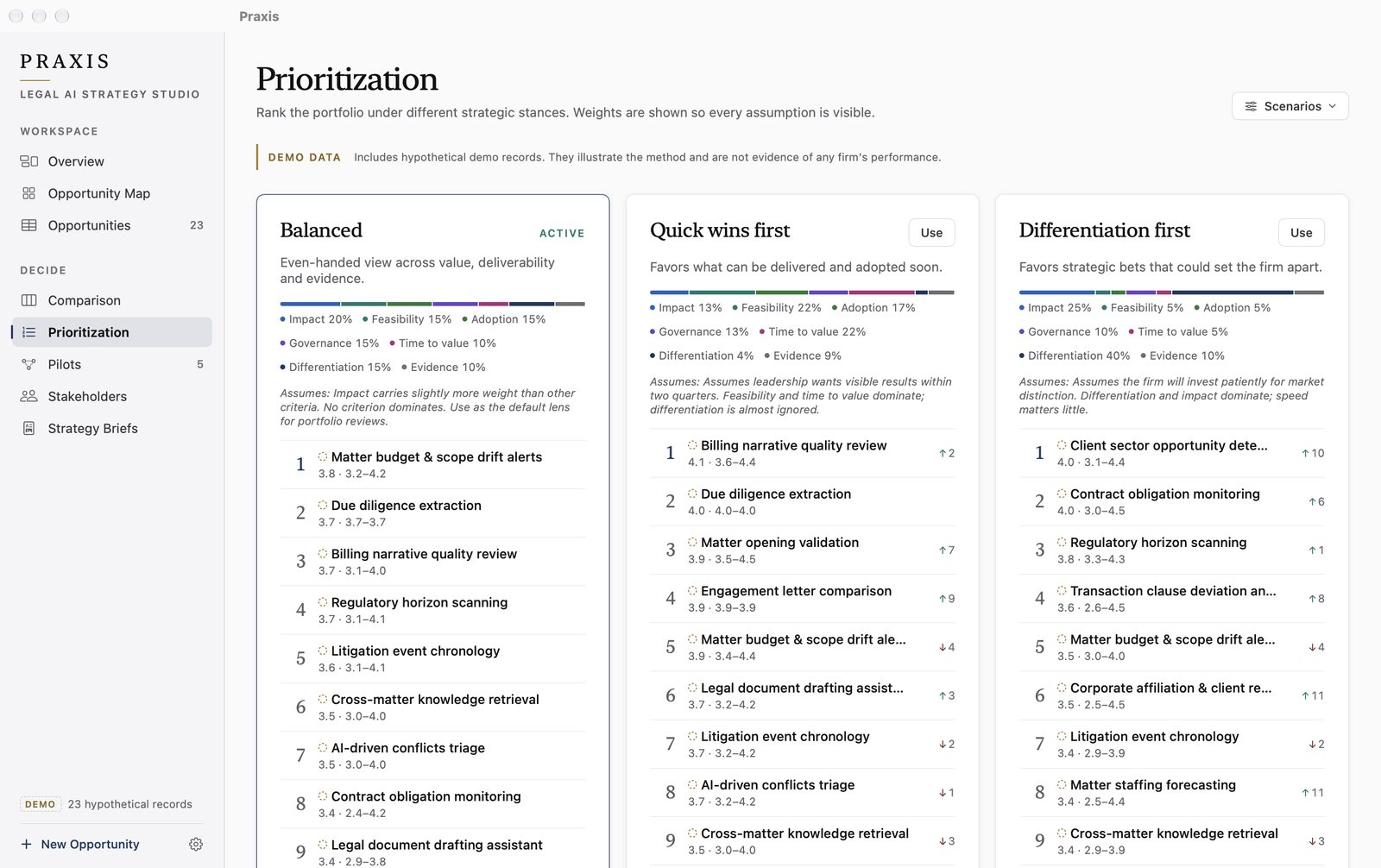
A native macOS app in SwiftUI and SwiftData that runs entirely on the Mac, with optional local (Ollama) or Claude assistance that shows the exact text before anything is sent. I set the brief and the design bar: white, editorial and calm enough for a partners' meeting. Claude Code wrote the app, its scoring engine and the demo portfolio, and built it on my Mac through Remote Control.
Case study 24 · Native Mac app · Legal intelligence
LexAtlas
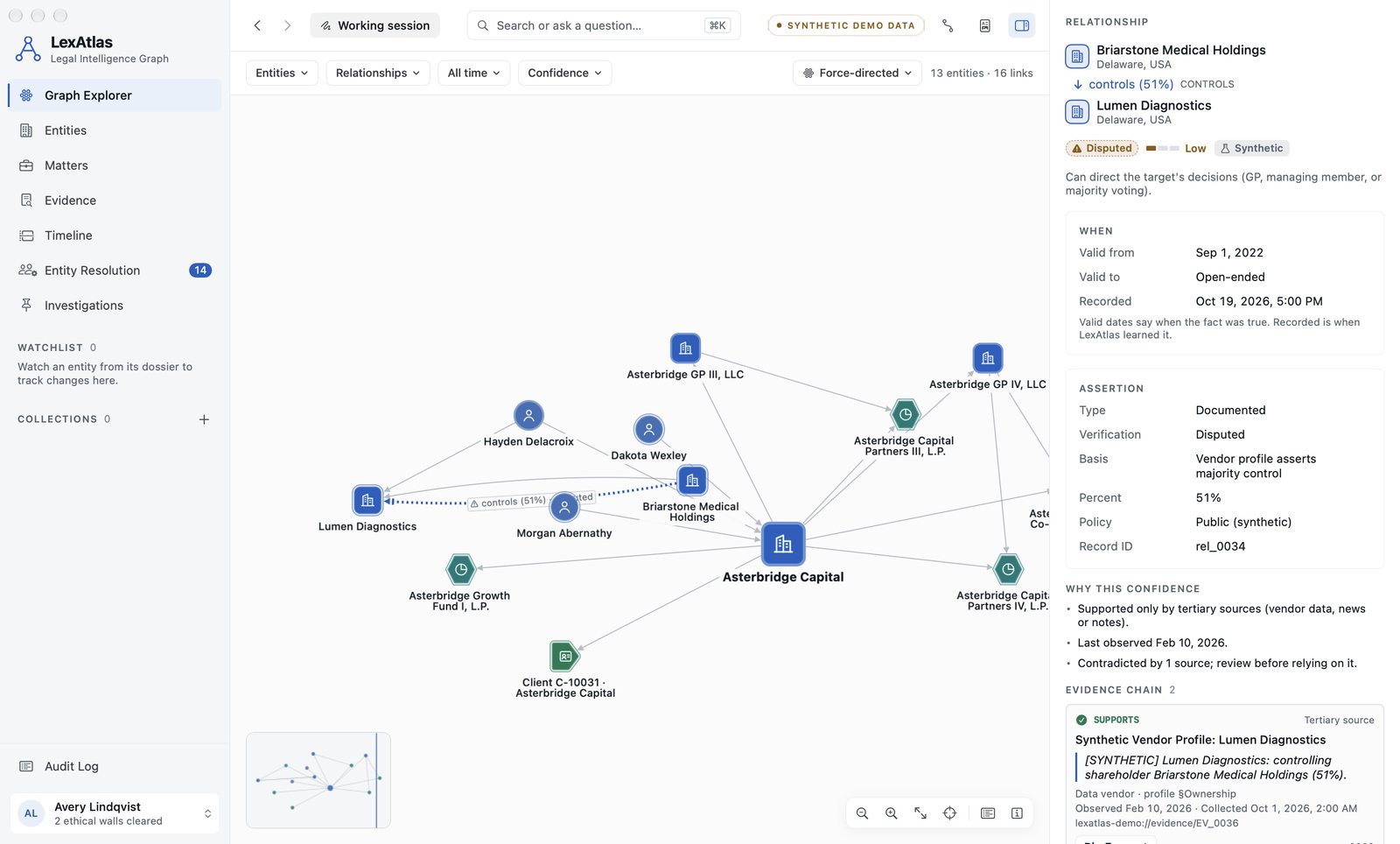
A legal intelligence graph for conflicts, diligence and investigations. It shows how companies, funds, people, matters and sources connect, ties every connection back to evidence, and enforces ethical walls in the data itself.
LexAtlas
A legal intelligence graph for conflicts, diligence and investigations. It shows how companies, funds, people, matters and sources connect, ties every connection back to evidence, and enforces ethical walls in the data itself.
Take the guided tourScreens from the running Mac app, with a fully fictional dataset
The problem
Conflicts and diligence questions are graph questions: is this fund related to our client, who controlled this company in 2023, how is this buyer connected to that target? Firms answer them from spreadsheets and vendor feeds that disagree, with no record of which source said what, and with walled matters that can leak through a search result or a count.
What it does
- A graph explorer and path finder that answers "how are these two connected" within the records the user is cleared to see.
- Evidence on every edge, with rule-based confidence that always gives its reasons, and disputed, stale or inferred links drawn differently.
- Time travel: the graph as of any date, and what began or ended between two dates.
- Ethical walls in the data layer, reversible entity resolution, saved investigations and a cited brief that exports as Markdown, PDF and JSON.
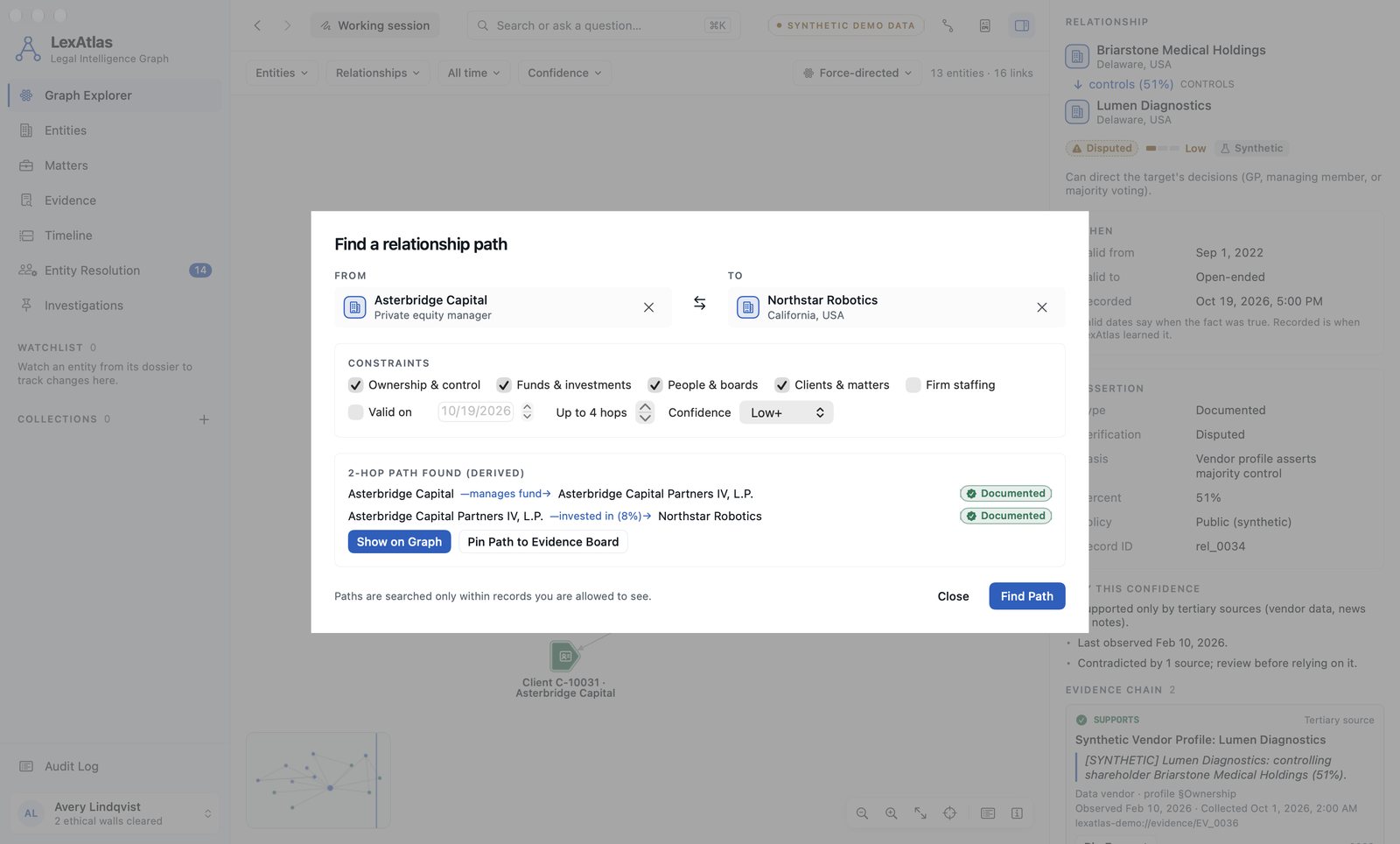
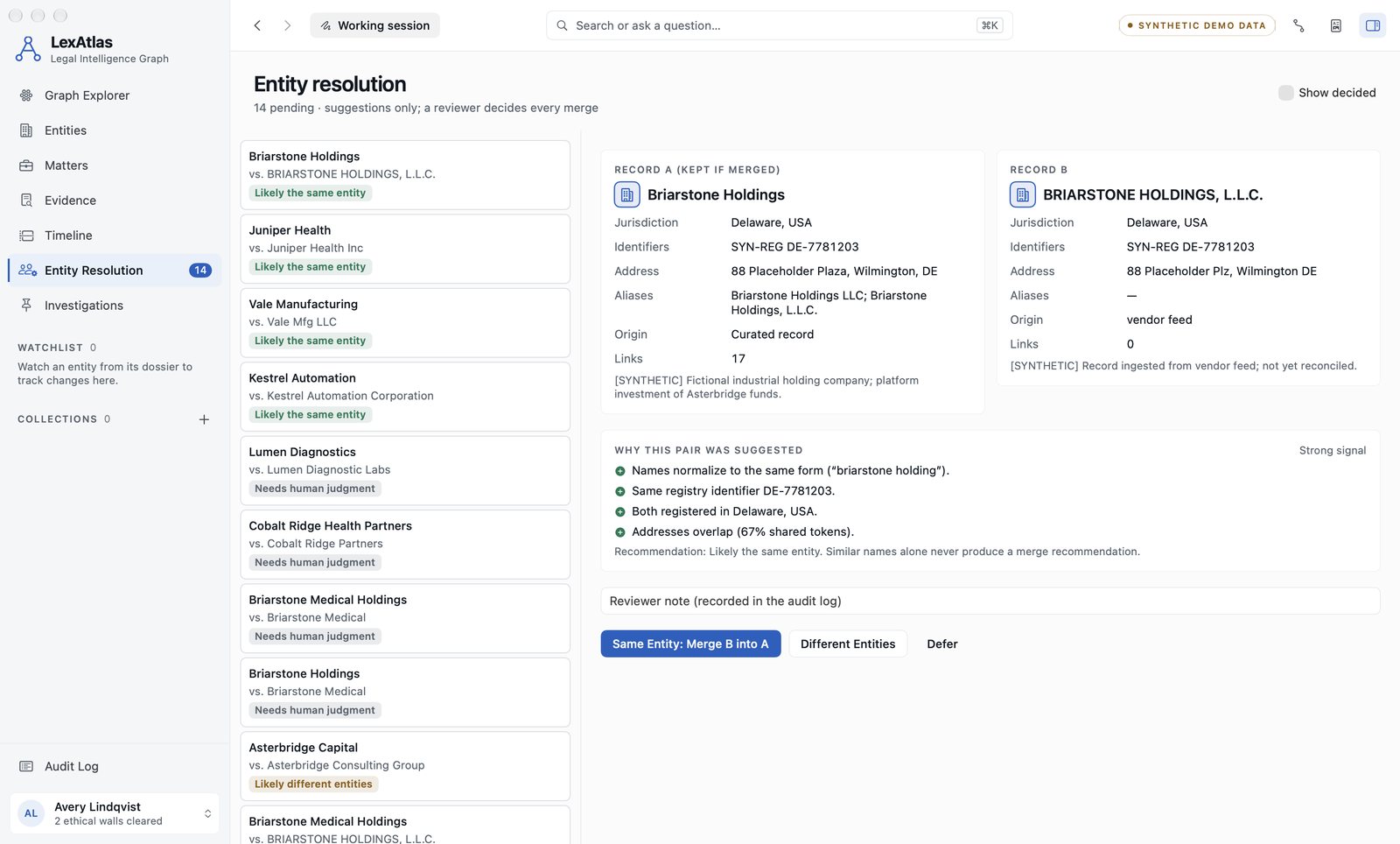
A native macOS app in SwiftUI over system SQLite, with an offline graph canvas and optional local or Claude assistants that are off by default. I wrote the specification package; Claude Code built the app and its synthetic dataset and ran the builds on my Mac through Remote Control. The working default is a quiet white workspace, and its eleven other skins live only in Settings.
Case study 25 · Native Mac app · Legal AI assistant
Skippy
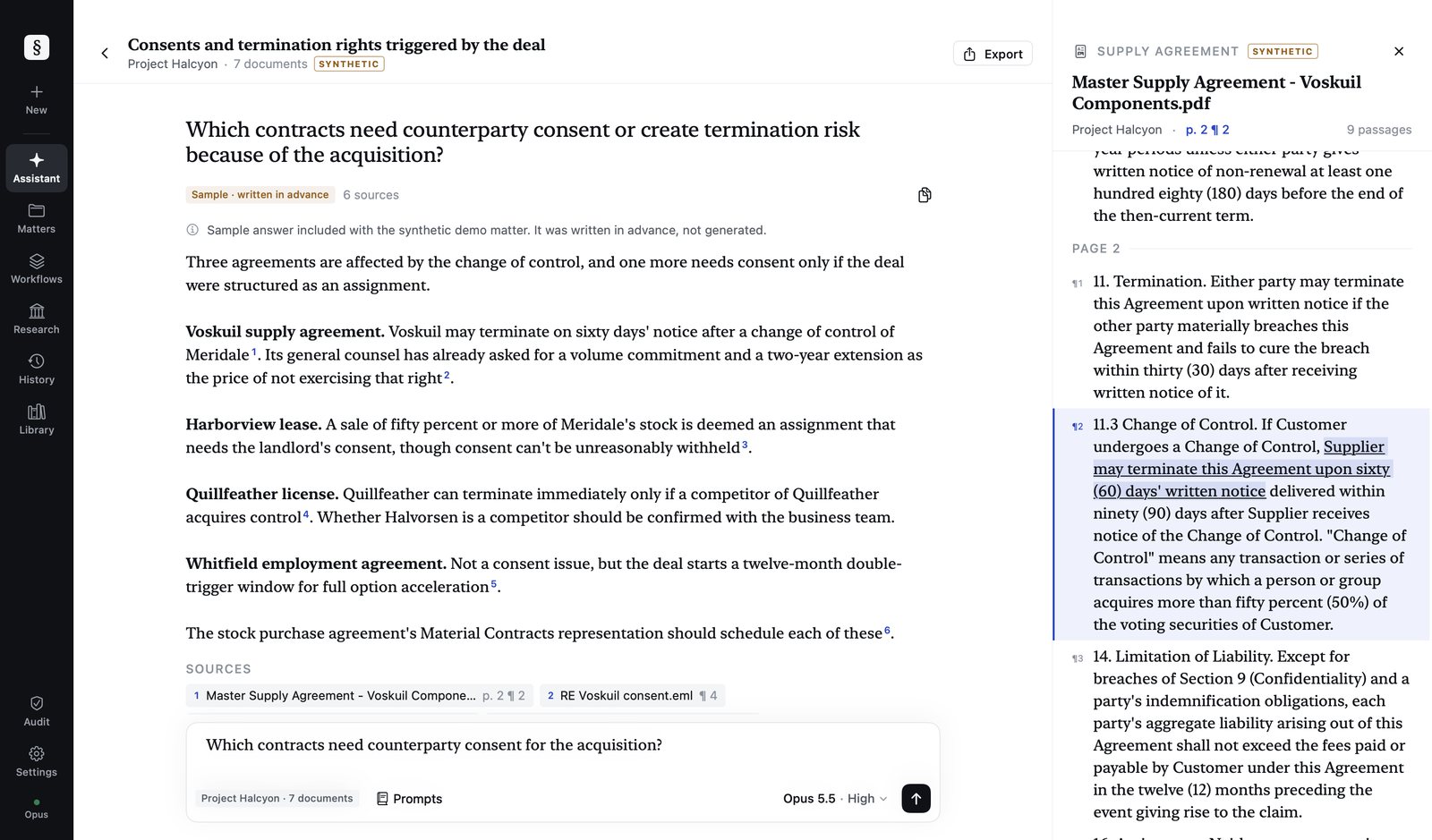
A legal AI assistant for the Mac, built on Claude. Lawyers keep each matter's documents together, ask questions and get answers cited to the page and paragraph, run review tables, redline drafts, check citations and count deadlines, and nothing reaches the cloud until they approve it.
Skippy
A legal AI assistant for the Mac, built on Claude. Lawyers keep each matter's documents together, ask questions and get answers cited to the page and paragraph, run review tables, redline drafts, check citations and count deadlines, and nothing reaches the cloud until they approve it.
Take the guided tourScreens from the running Mac app, with invented matters
The problem
Big-firm legal AI platforms are powerful but priced and deployed for big firms, and most general chat tools give answers a lawyer cannot check. A smaller practice needs the same core moves, ask, review, draft, verify, with every answer traceable to the record and a clear line on what client data leaves the building.
What it does
- Matters that hold PDFs (with OCR), Word, Excel, PowerPoint, email and more, read and split into passages on the Mac.
- Cited answers and review tables across many documents, with each quote located in Skippy's own copy and marked verified or not.
- Drafting with redlines, exported to Word with tracked changes, and multi-step workflows such as a due diligence report or a chronology of facts.
- Cite Check, Deadlines and public research through CourtListener, the Federal Register, eCFR and SEC EDGAR.
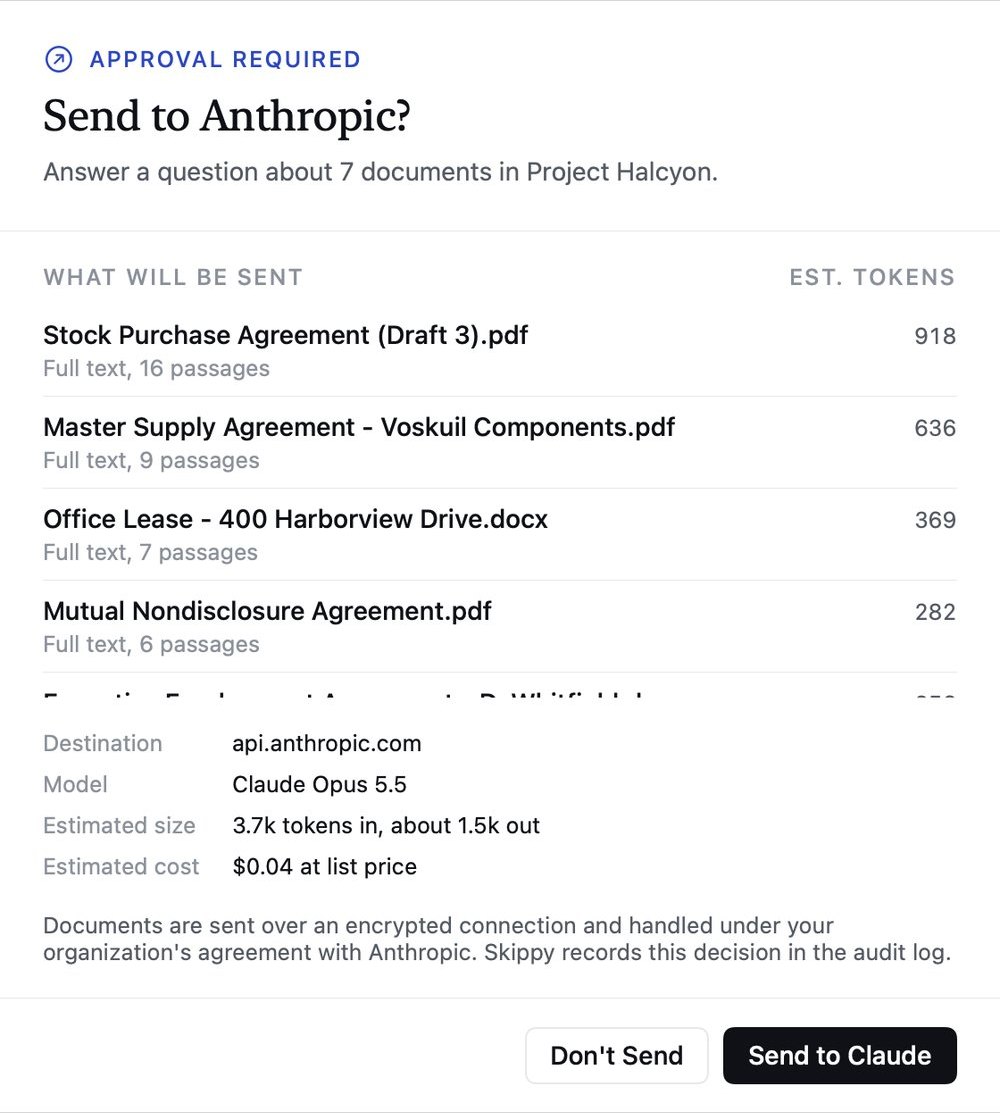
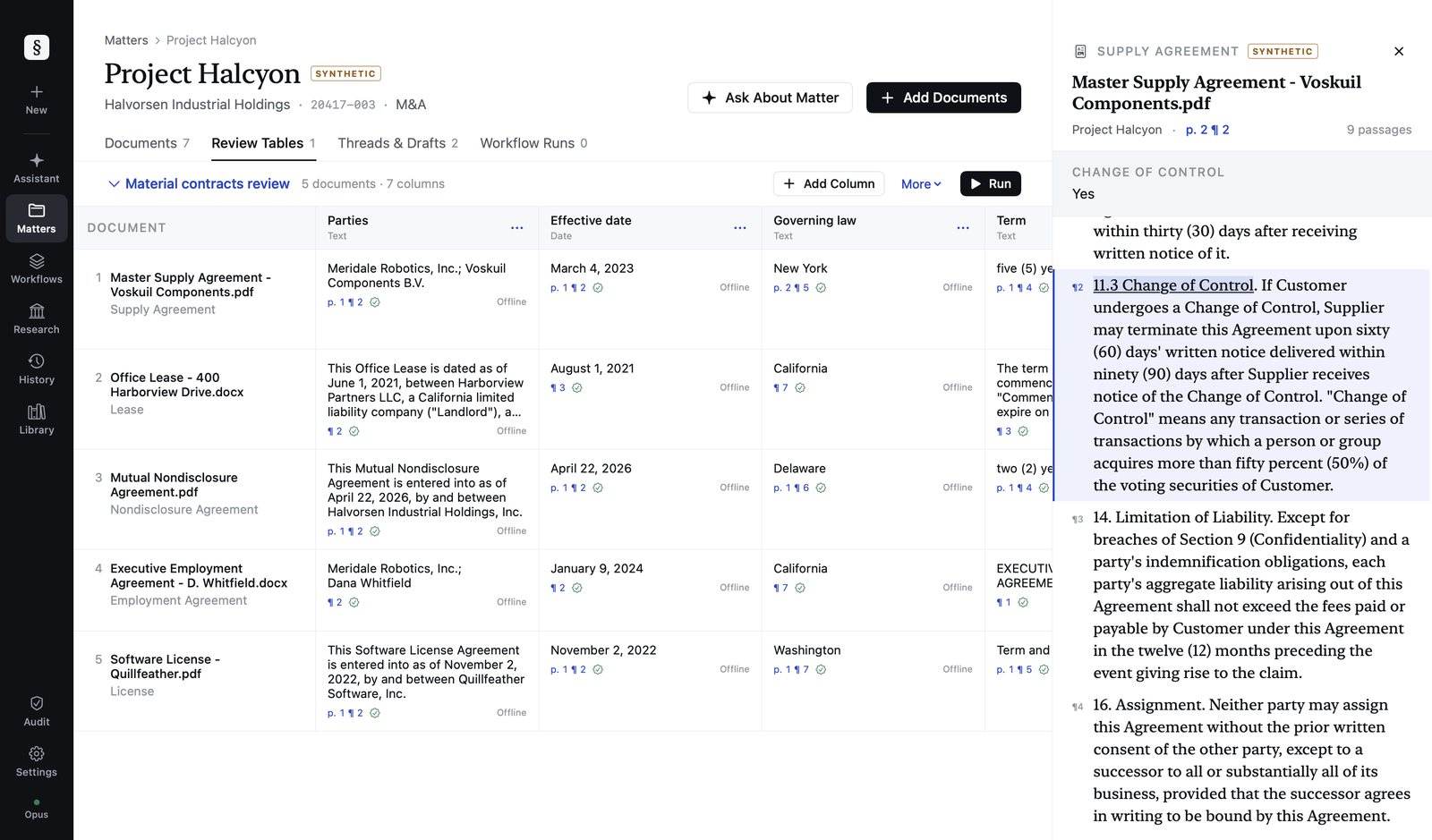
A native macOS app in SwiftUI with no third-party packages. It calls Claude through the Messages API, using citations on per-passage documents, structured outputs and prompt caching, or runs on the user's own Claude subscription, and works offline with local search when neither is available. A Confidentiality Shield can mask names before anything is sent. I set the goal and chose the extra features; Claude Code built it and ran the builds on my Mac.
Case study 09 · Legal AI
Win your case ASAP
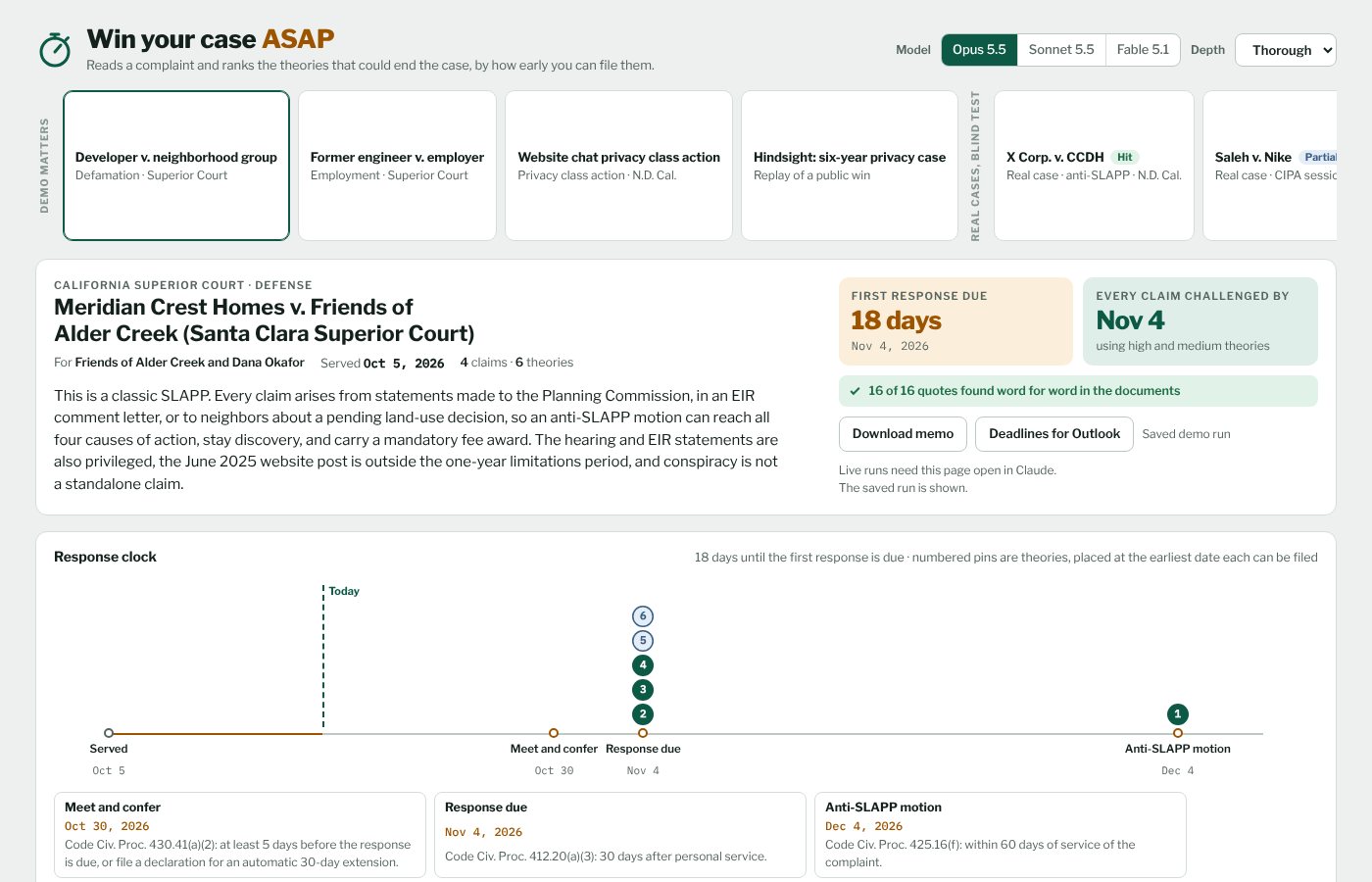
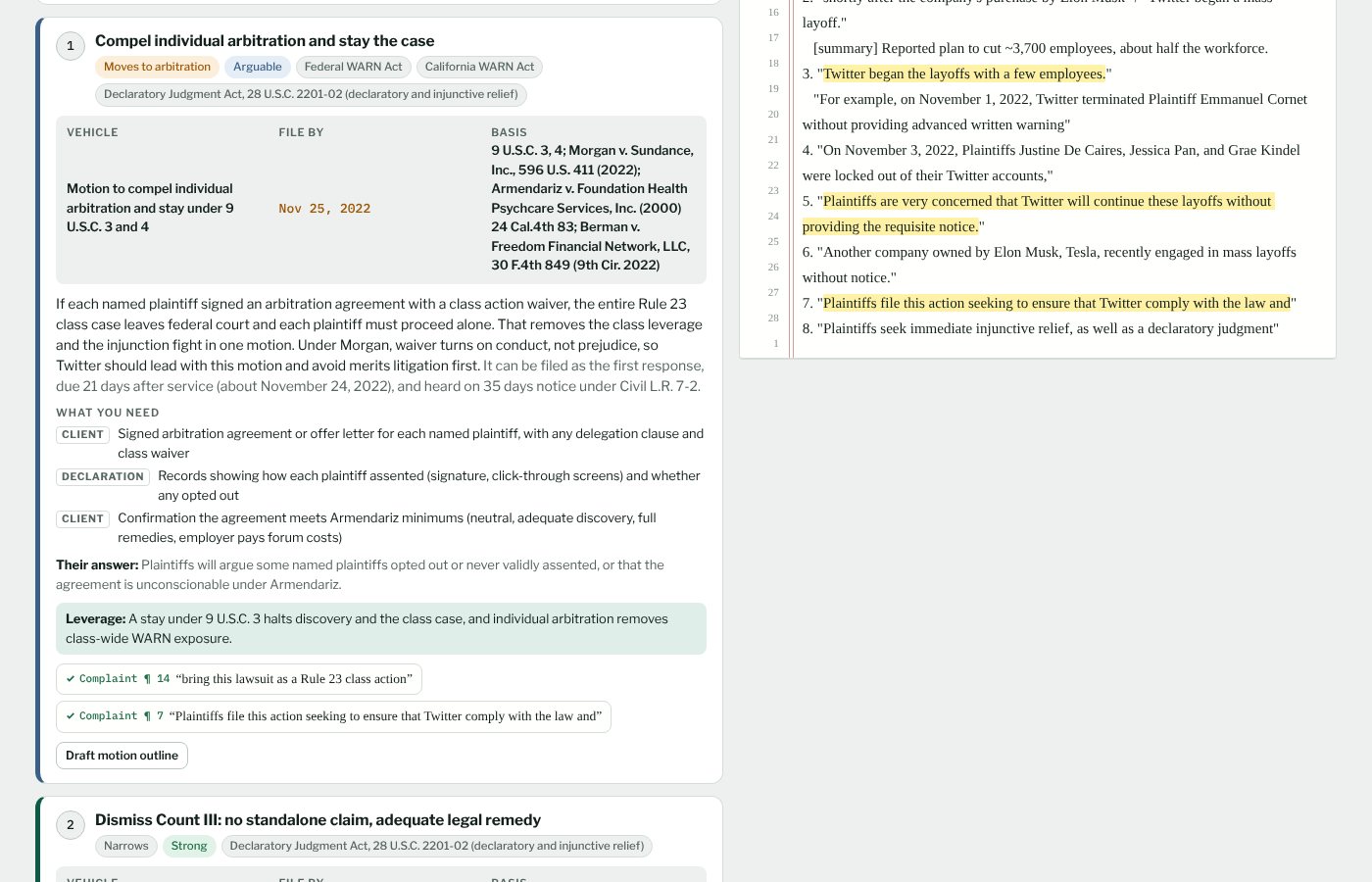
A litigator's first read of a new complaint, done in minutes. It ranks every theory that could end the case by how early it can be filed, puts each one on the response clock, and quotes the complaint for every point it makes. Run blind on 26 California federal cases decided after the model’s training cutoff, the ground that actually won made its top three in 14, and 357 of 358 quotations checked out word for word.
Try the demoSaved runs on this site; live analysis runs inside Claude
The problem
The cheapest way to win a lawsuit is to end it early: an anti-SLAPP motion, a demurrer, a motion to compel arbitration, a statute of limitations defense. Those windows open and close in the first weeks after service, often before anyone has read the complaint closely with that question in mind. Miss one and a case that could have ended in month two runs for years.
What it does
- Ranked theories: each with the motion that carries it, the date it can be filed, the authority, what the client must supply, the other side's best answer, and how far it gets (ends the case, narrows it, or moves it).
- A response clock built from the forum's own rules, such as the 60-day anti-SLAPP window or the 30-day state response deadline, with dates exportable to Outlook.
- A claim-by-theory grid showing which theory reaches which claim, first moves for this week, and checkpoints a lawyer must confirm.
- A whole case file: PDFs, Word files and emails, read in passes when the file is large, and a draft motion outline or memo on request.
Tested against what actually happened
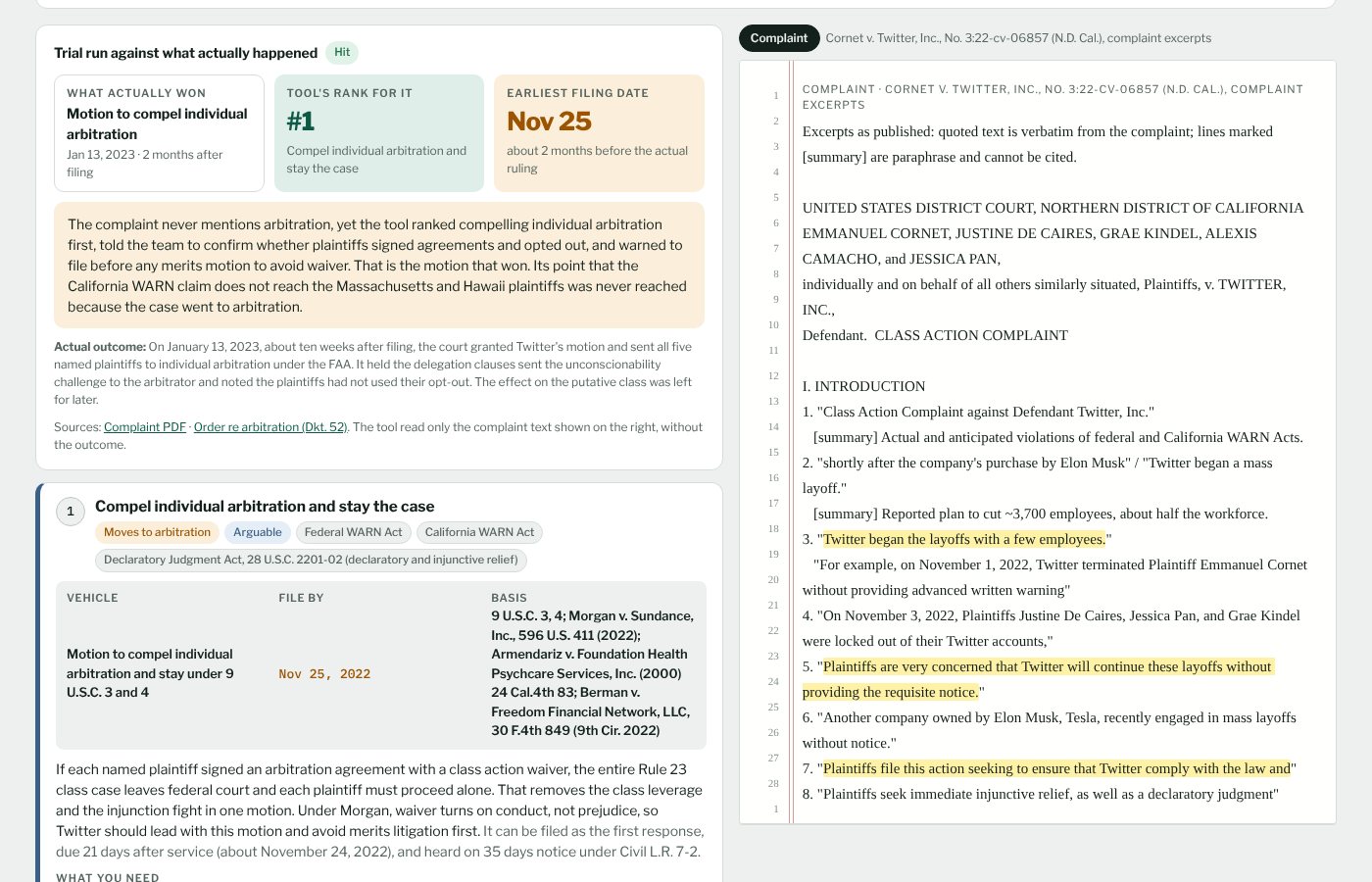
For each case the tool read only the complaint, as of filing, without the outcome. Its ranked theories were then scored against what the court actually did.
26 cases the model could not have seen
California federal cases decided after the model’s training cutoff, so it could not have known how they ended. Each was scored against the court’s ruling.
The winning ground in its top three, 14 of 26 times
Each ranked theory was scored against what the court actually did, from a complaint read as of filing, without the outcome.
Quotes that check themselves
Across the 26 cases, 357 of 358 quoted passages were found word for word in the complaint.
Decisions behind it
- Earliest first. Theories are ordered by when they can be filed and how much of the case they end, because the value is in the weeks saved.
- Code checks the model. Deadlines come from coded forum rules, and every quote is matched against the source text in the browser.
- A lawyer decides. Each theory lists the facts a lawyer must confirm before relying on it, such as whether the plaintiffs actually signed an arbitration agreement.
- Model choice. Opus, Sonnet or Fable, with a depth setting, so a team can trade speed against thoroughness.
Built to run where lawyers already work
It is a single page that runs inside Claude on the user's own account, so it needs no new vendor, server or install. Large case files are read in 140,000-character passes, two at a time; only facts whose quotes verify are carried forward to one final ranking pass. The real cases use public complaint text and public rulings, with sources linked in the tool.
Built with Claude Code as a page that calls Claude for the analysis. I set the goal, an early exit from every case, and the test: run it blind on real complaints, including ones decided after the model’s cutoff, and score it against what the court actually did. Claude wrote the page, the forum rules and the demo matters, found the public cases, and wrote up each scorecard for me to review.
Case study 10 · Litigation cheat code
Testimony Check
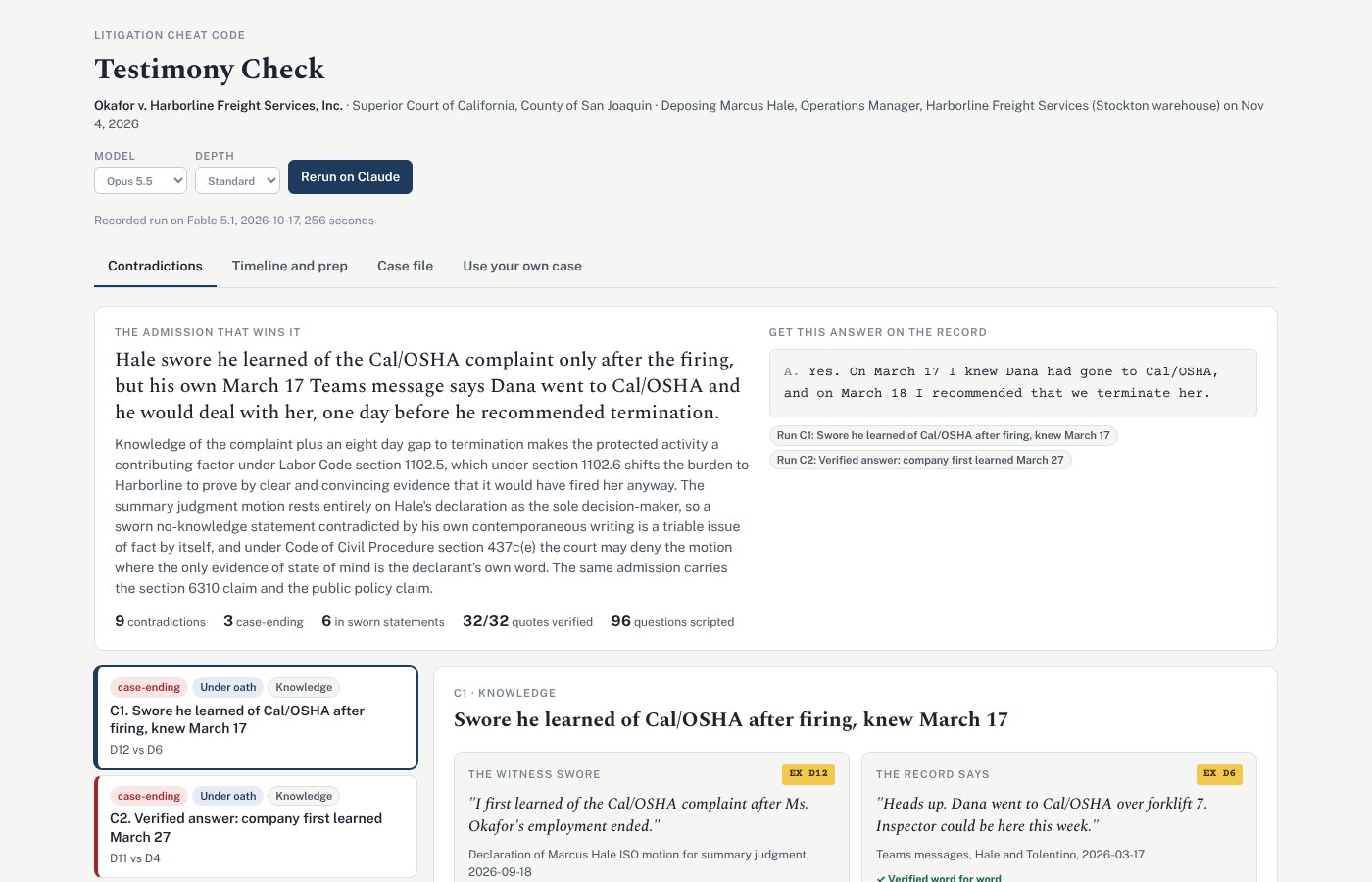
Feed it the documents in a case and a witness’s sworn statements, and it finds every place the story breaks, with the exact quotes on both sides and a deposition script that walks the witness into the admission.
Testimony Check
Feed it the documents in a case and a witness’s sworn statements, and it finds every place the story breaks, with the exact quotes on both sides and a deposition script that walks the witness into the admission.
Try the demoSaved runs on this site; live analysis runs inside Claude
The problem
Depositions are won on the contradictions, and finding them means holding a declaration, an email thread, a performance file and a chat log in your head at once. Associates do it by hand over days, and a missed contradiction is not recoverable once the witness has been prepared and sworn.
What it does
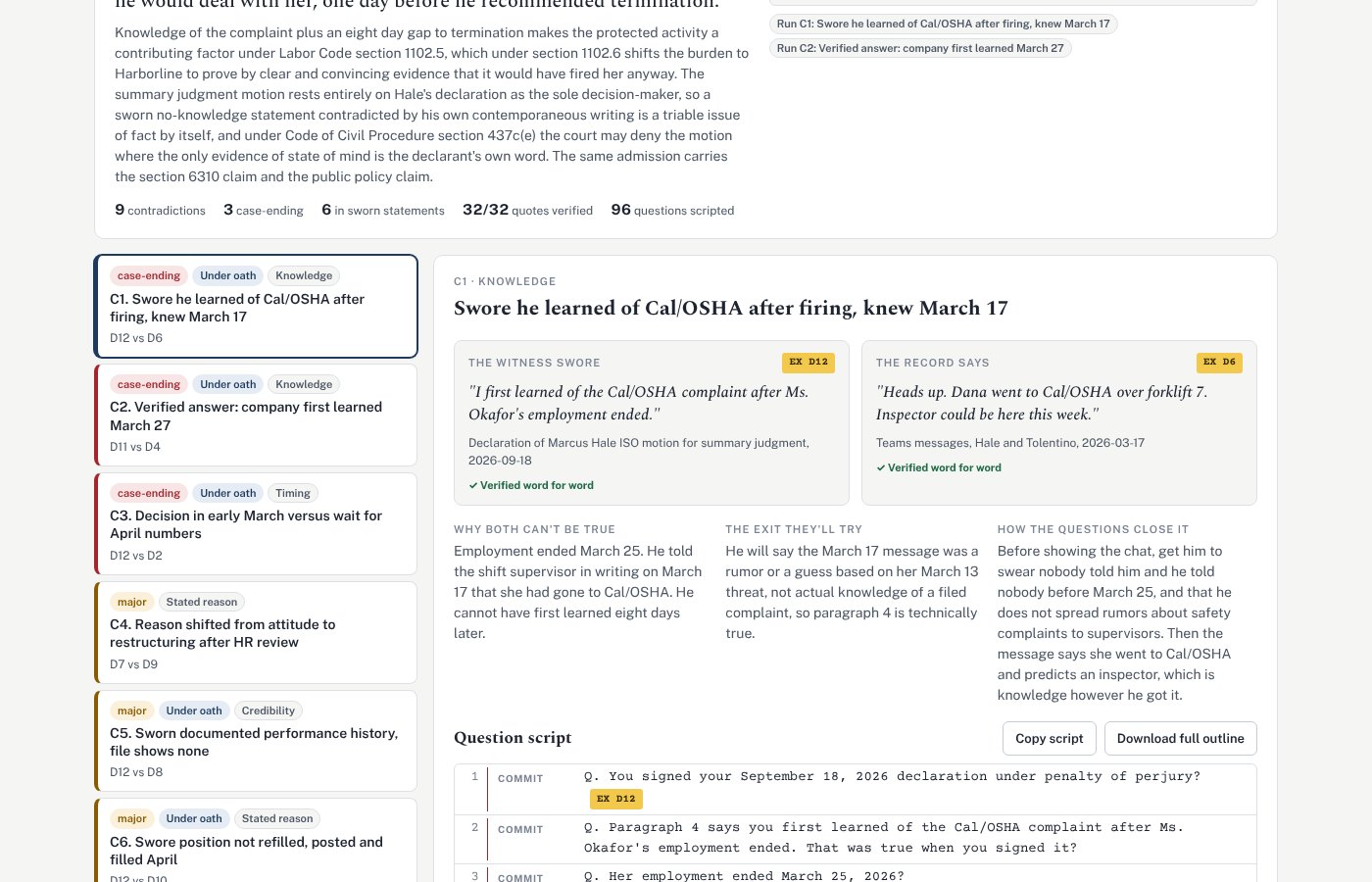
- Ranks contradictions as case-ending, major or useful, and flags which statements were made under oath.
- Shows both sides with the exact quote and the document it came from.
- Predicts the way out: what the witness will say to explain it away, and how to close that exit.
- Writes the deposition script as commit, confront and close questions, and lists what not to ask.
- Takes a real case file: upload documents or paste in your own.
Decisions behind it
- Quotes are checked by code. Every quoted passage is matched word for word against the source document in the browser, and anything that does not match is flagged.
- Order matters. The kill shot is one admission, the sequence to get it, and why it ends the issue.
- A lawyer decides. It prepares the examination; it does not decide what to ask.
What the recorded run showed
It read 13 documents in 256 seconds and found 9 contradictions, 3 of them case-ending, with all 32 quotes verified. In a mock deposition where Claude played a coached witness, the scripted questions produced the key admission at question 8.
Built with Claude Code as a page that calls Claude for the analysis. I set the idea and the test; Claude wrote the page and prompts, and a script recorded the run shown here.
Case study 11 · Litigation screen
Citation Gate
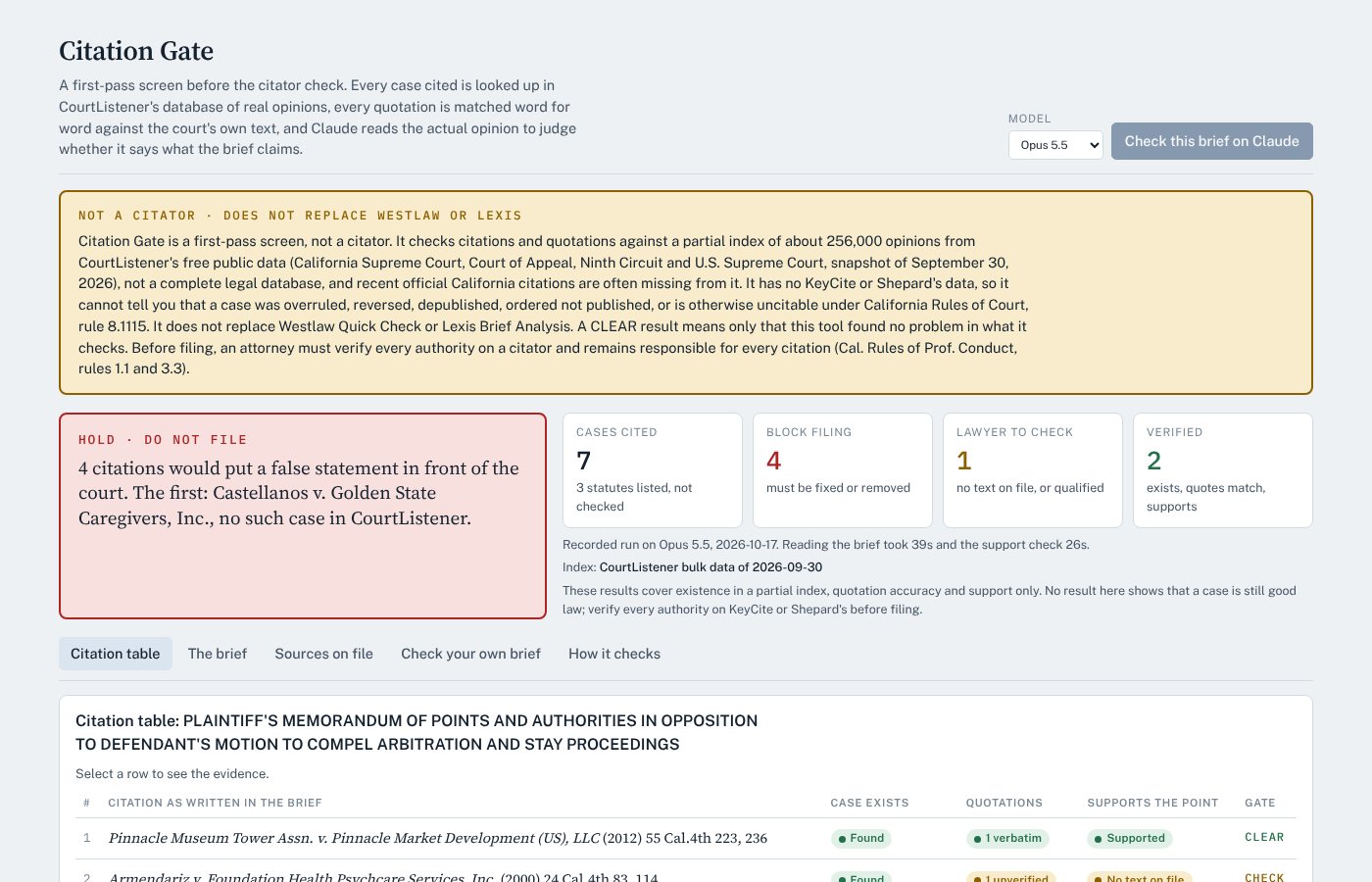
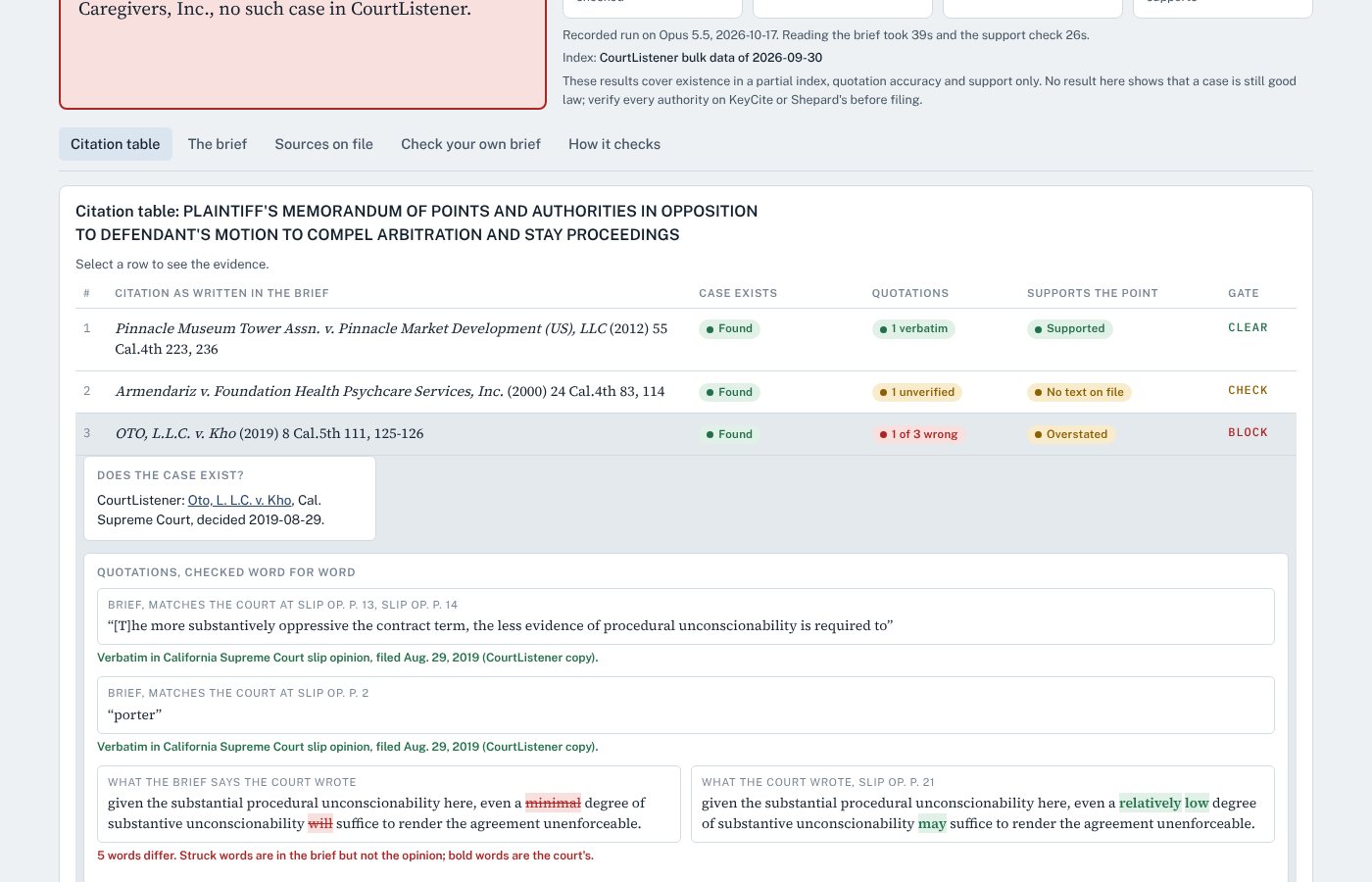
A first-pass screen that runs before the citator check. Every case cited is looked up in a database of real opinions, every quotation is matched word for word against the court’s text, and Claude reads the actual opinion to judge whether it says what the brief claims.
Citation Gate
A first-pass screen that runs before the citator check. Every case cited is looked up in a database of real opinions, every quotation is matched word for word against the court’s text, and Claude reads the actual opinion to judge whether it says what the brief claims.
Screenshots below
Citations and quotations, against an index of about 256,000 opinions from CourtListener’s free public data (California Supreme Court, Court of Appeal, Ninth Circuit and U.S. Supreme Court, snapshot of September 30, 2026). It is built to sit beside a citator: the attorney verifies every authority before filing.
The problem
Courts have begun sanctioning lawyers for citations to cases that do not exist, quotations that are not in the opinion, and holdings that say the opposite. The risk grows as more drafting is assisted by AI, and an associate cite-checking at midnight is the only barrier.
What it does
- Extracts every authority from a brief: cite, pin cite, quotations and the proposition each is cited for.
- Looks up each case in a local index built from CourtListener, and flags a citation that belongs to a different case.
- Matches every quotation against the opinion text, word for word, and marks the words that differ.
- Reads the opinion to judge whether it supports the point, and routes anything uncertain to a lawyer.
- Signs off: a table a lawyer signs, exported as a file or CSV. The sign-off states that every authority was also checked on KeyCite or Shepard’s.
Decisions behind it
- Lookup first, model second. Existence and quotation checks are plain code against real text; the model only judges support.
- No text, no pass. A case with no opinion on file is marked for a lawyer and never passed.
- Say what it did not check. Statutes and rules are listed as not checked, and even a clean result is stamped “no issues found, citator check still required.”
What the recorded run showed
On a 7-case brief with problems planted, it blocked all four: two made-up or mismatched cases, one misquote and one wrong proposition. It found no problem with the two accurate citations, which still need a citator check, and sent the rest to a lawyer rather than guessing.
Built with Claude Code as a page that calls Claude for the analysis. I set the idea and the test; Claude wrote the page and prompts, and a script recorded the run shown here.
Case study 12 · Billing compliance
Guideline Guard
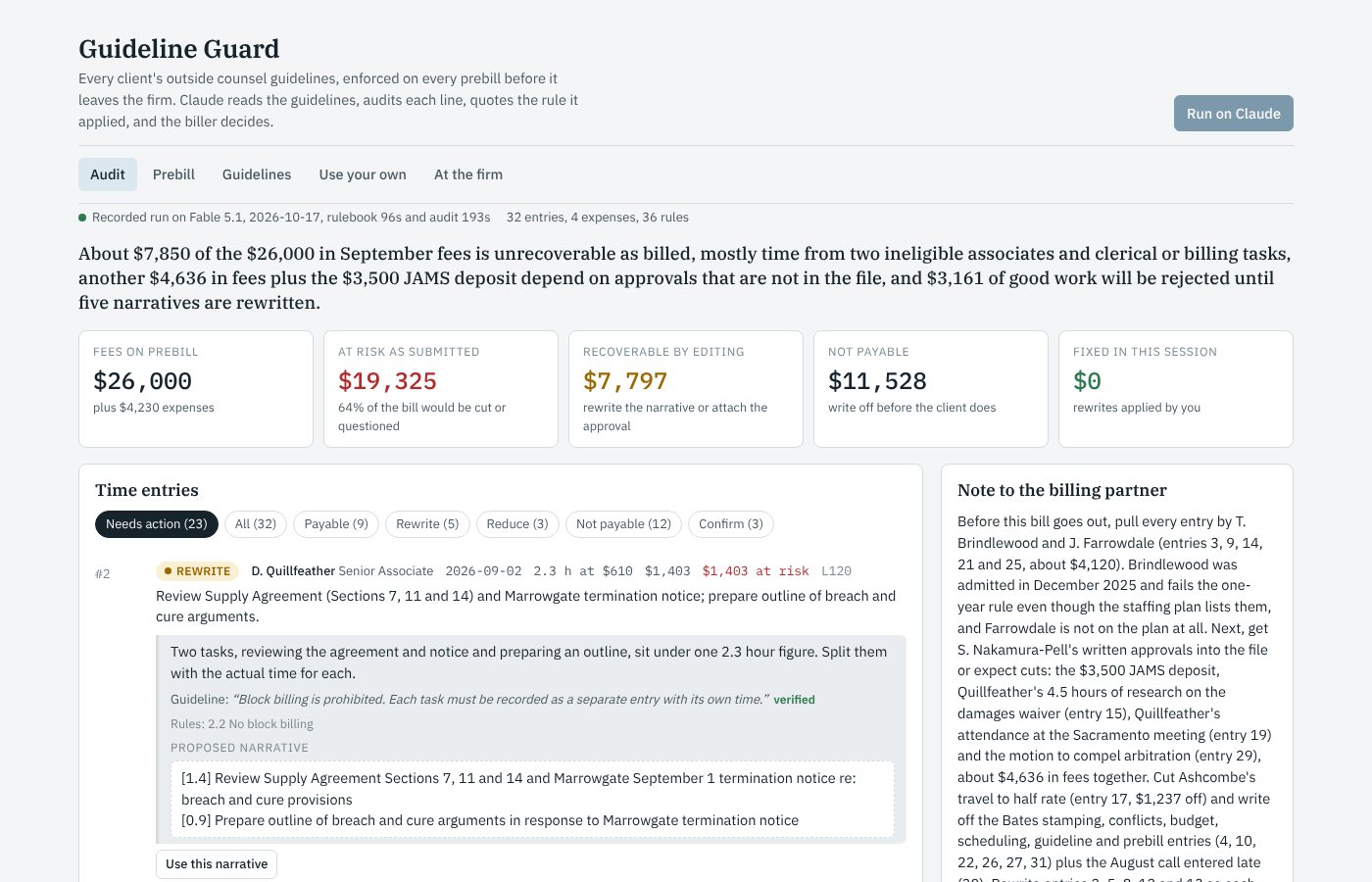
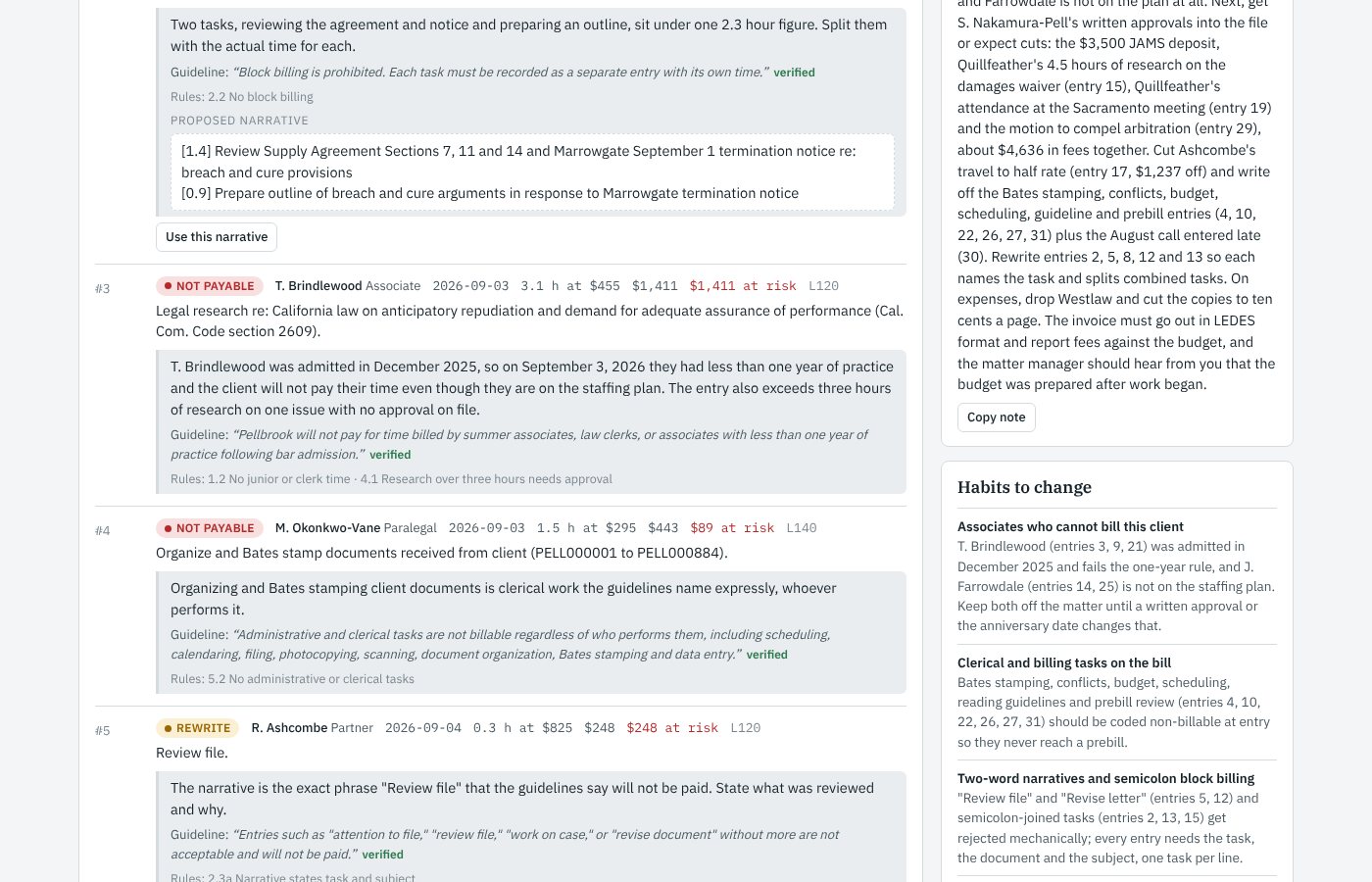
Every client’s outside counsel guidelines, enforced on each prebill before it leaves the firm. Claude reads the guidelines, audits each line, quotes the rule it applies and proposes the fix.
Guideline Guard
Every client’s outside counsel guidelines, enforced on each prebill before it leaves the firm. Claude reads the guidelines, audits each line, quotes the rule it applies and proposes the fix.
Try the demoSaved runs on this site; live analysis runs inside Claude
The problem
Clients now send guidelines that decide what they will pay: who may bill, at what rate, how entries are written, which tasks are never billable. Finance finds violations after the invoice is rejected, weeks later, when the work cannot be corrected and the write-off is already coming.
What it does
- Extracts a rulebook from the client’s guidelines, each rule with its category, a test and the exact sentence it comes from.
- Audits every entry as payable, rewrite, reduce, not payable or confirm.
- Quotes and verifies the rule behind each finding in the page.
- Proposes narratives that meet the rule, and writes a note to the billing partner.
- Exports to CSV for the billing team.
Decisions behind it
- Before the invoice, not after. It runs on the prebill export, when the entry can still be fixed.
- No new vendor. It runs on the firm’s existing Claude and a billing export.
What the recorded run showed
It extracted 36 rules and audited the 32-entry prebill, finding that $19.3k of the $26k in fees would be cut or questioned as submitted and $7.8k of that was recoverable by rewriting or attaching approvals.
Built with Claude Code as a page that calls Claude for the analysis. I set the idea and the test; Claude wrote the page and prompts, and a script recorded the run shown here.
Case study 13 · Time capture
Hour Catch
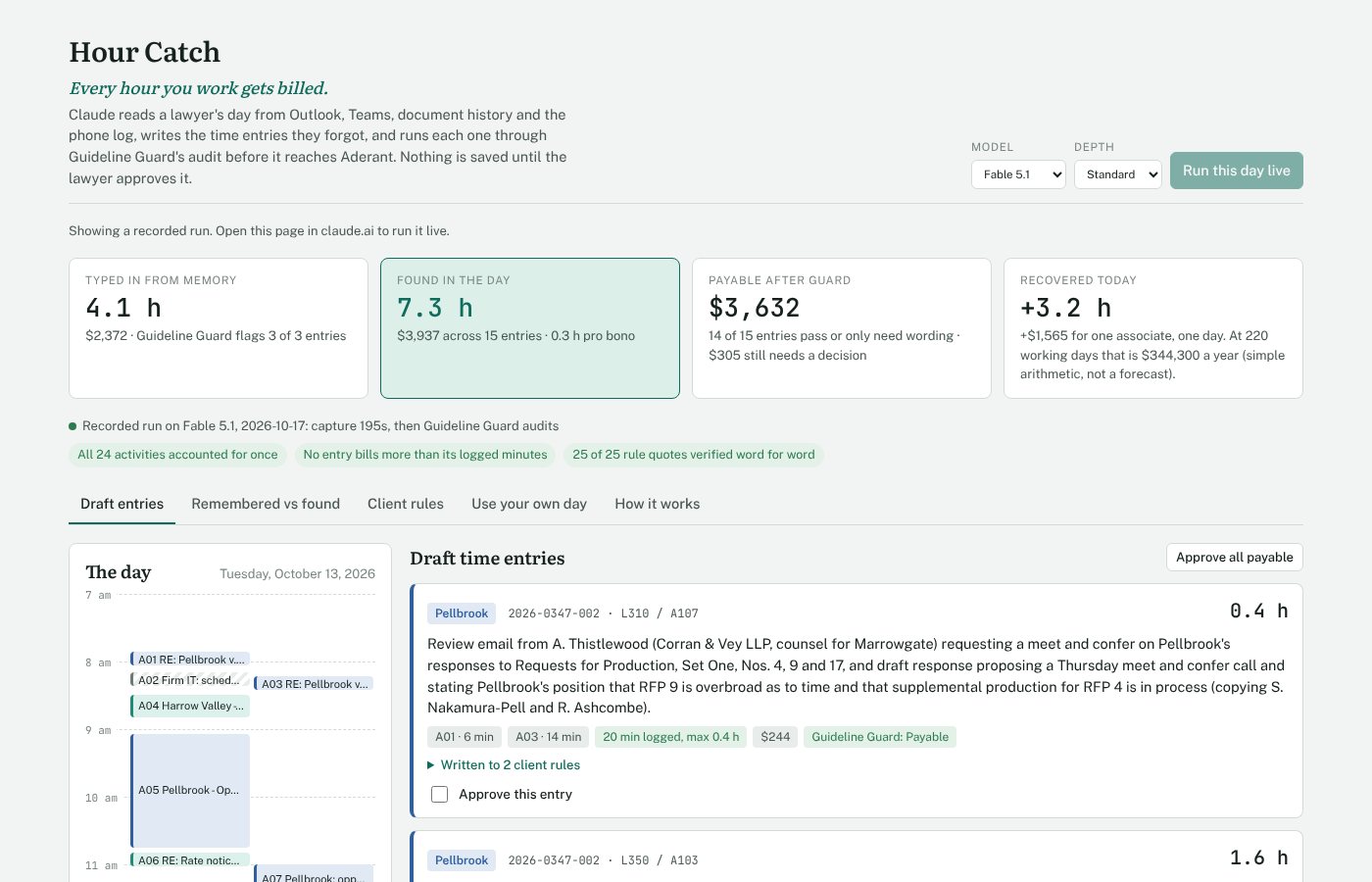
Every hour you work gets billed. It reads a lawyer’s day across Outlook, Teams, document history and the phone log, writes the time entries they forgot, and runs each one through Guideline Guard before it reaches billing.
Hour Catch
Every hour you work gets billed. It reads a lawyer’s day across Outlook, Teams, document history and the phone log, writes the time entries they forgot, and runs each one through Guideline Guard before it reaches billing.
Try the demoSaved runs on this site; live analysis runs inside Claude
The problem
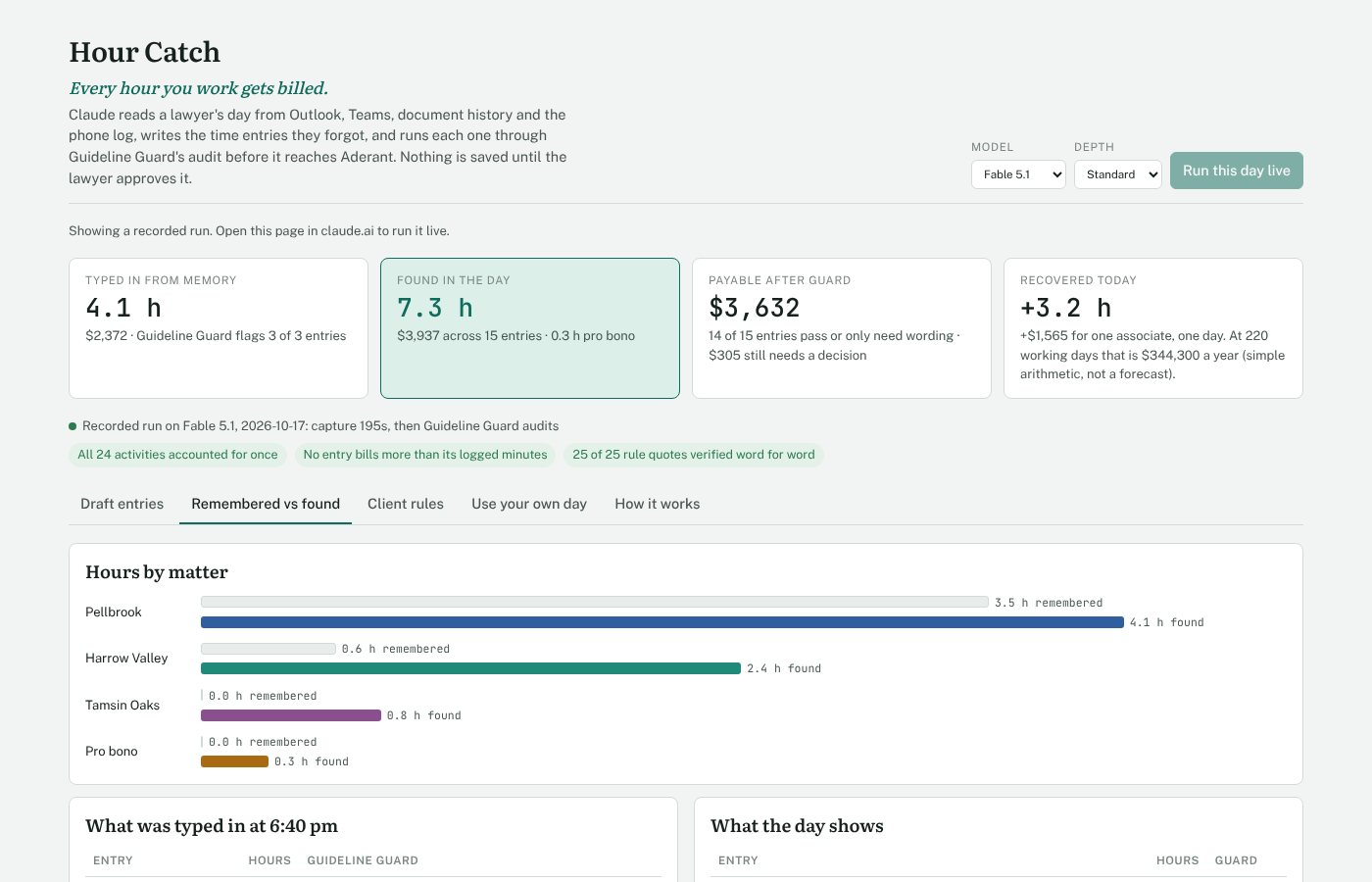
Time that is worked and not recorded is never billed. Lawyers reconstruct their day from memory at 6:40 pm and reliably remember the long tasks and forget the short ones. Across a firm, even one recovered hour a day is a very large number.
What it does
- Reads the day from the sources a lawyer already works in and accounts for every activity once.
- Drafts the entries in 0.1-hour increments with narratives written to the client’s rules.
- Runs the guard on each draft so a recovered hour does not turn into a rejected one.
- Waits for approval: nothing is saved to billing until the lawyer approves.
- Compares remembered time against found time, by matter.
Decisions behind it
- Approve first. Drafts are never posted; the lawyer approves each entry.
- Compliance in the same step. The guard’s audit is part of capture, so the narratives come out compliant.
- Say what it assumes. The $344,300 a year figure on the page is labelled simple arithmetic, not a forecast.
What the recorded run showed
On one lawyer’s day it found 7.3 hours against the 4.1 hours the lawyer would have entered, drafted 15 entries and kept $3,632 payable after the audit. Every activity is accounted for once, and no entry bills more than its logged minutes.
Built with Claude Code as a page that calls Claude for the analysis. I set the idea and the test; Claude wrote the page and prompts, and a script recorded the run shown here.
Case study 14 · Conflicts
Party Finder
No conflict hides in the paperwork. It reads the complaint, deal documents or engagement request, builds the complete list of names to search, and ties each name to the sentence it came from. The list goes into the firm’s conflicts system, which stays the system of record.
Party Finder
No conflict hides in the paperwork. It reads the complaint, deal documents or engagement request, builds the complete list of names to search, and ties each name to the sentence it came from. The list goes into the firm’s conflicts system, which stays the system of record.
Try the demoSaved runs on this site; live analysis runs inside Claude
The problem
A conflicts search is only as good as the list of names put into it, and the list comes from an intake form with a few names. The parties that create conflicts are usually in the paperwork: a former name, a parent, an insurer, a co-defendant, a trustee.
What it does
- Reads the documents and builds a party register with each party’s role, side and relationship.
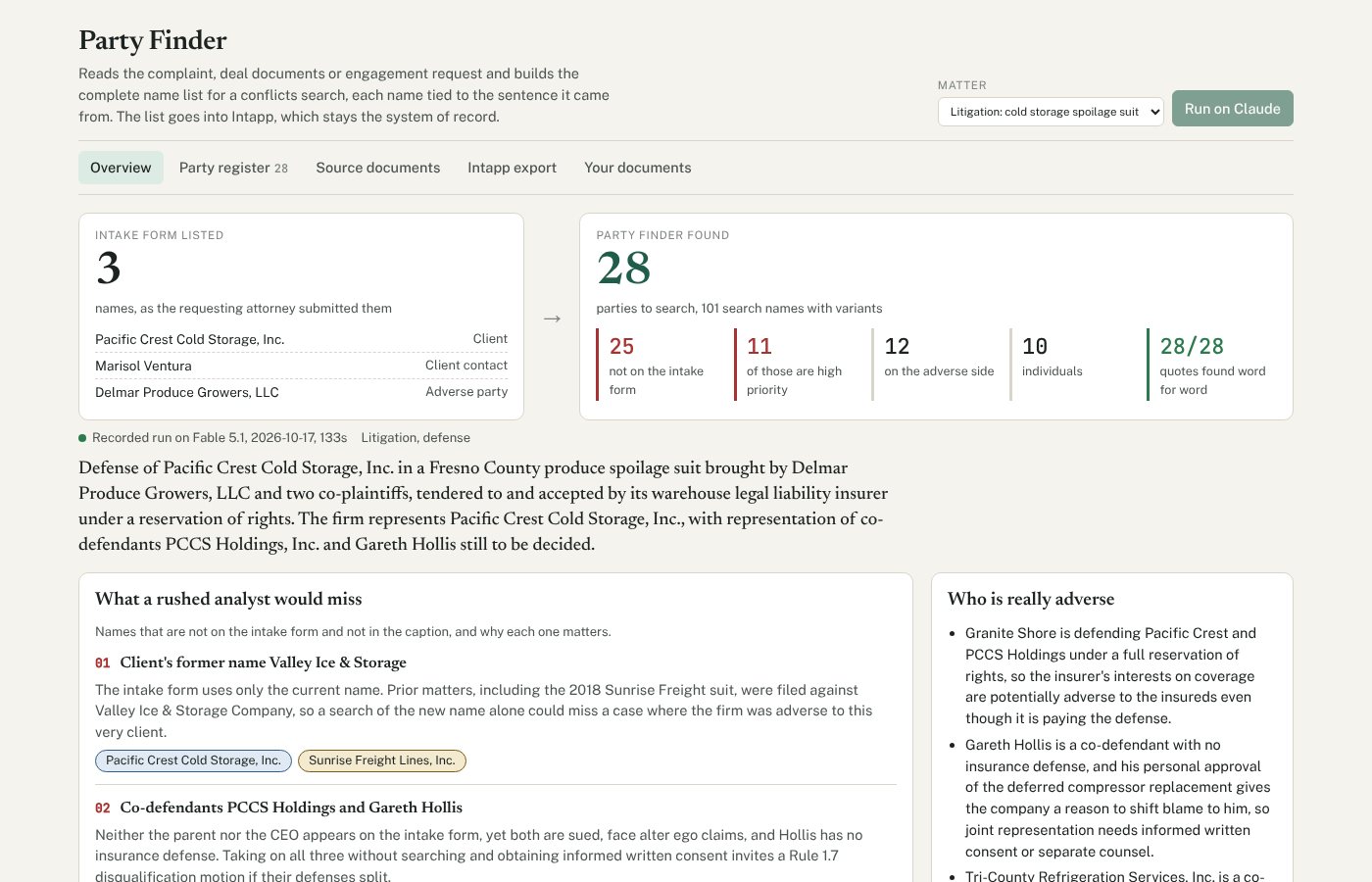
- Finds what an intake form misses: former names, parents, affiliates, insurers, counsel, and officers.
- Explains who is really adverse and why a name matters, ranked by priority.
- Quotes the source sentence for every name, checked word for word in the page.
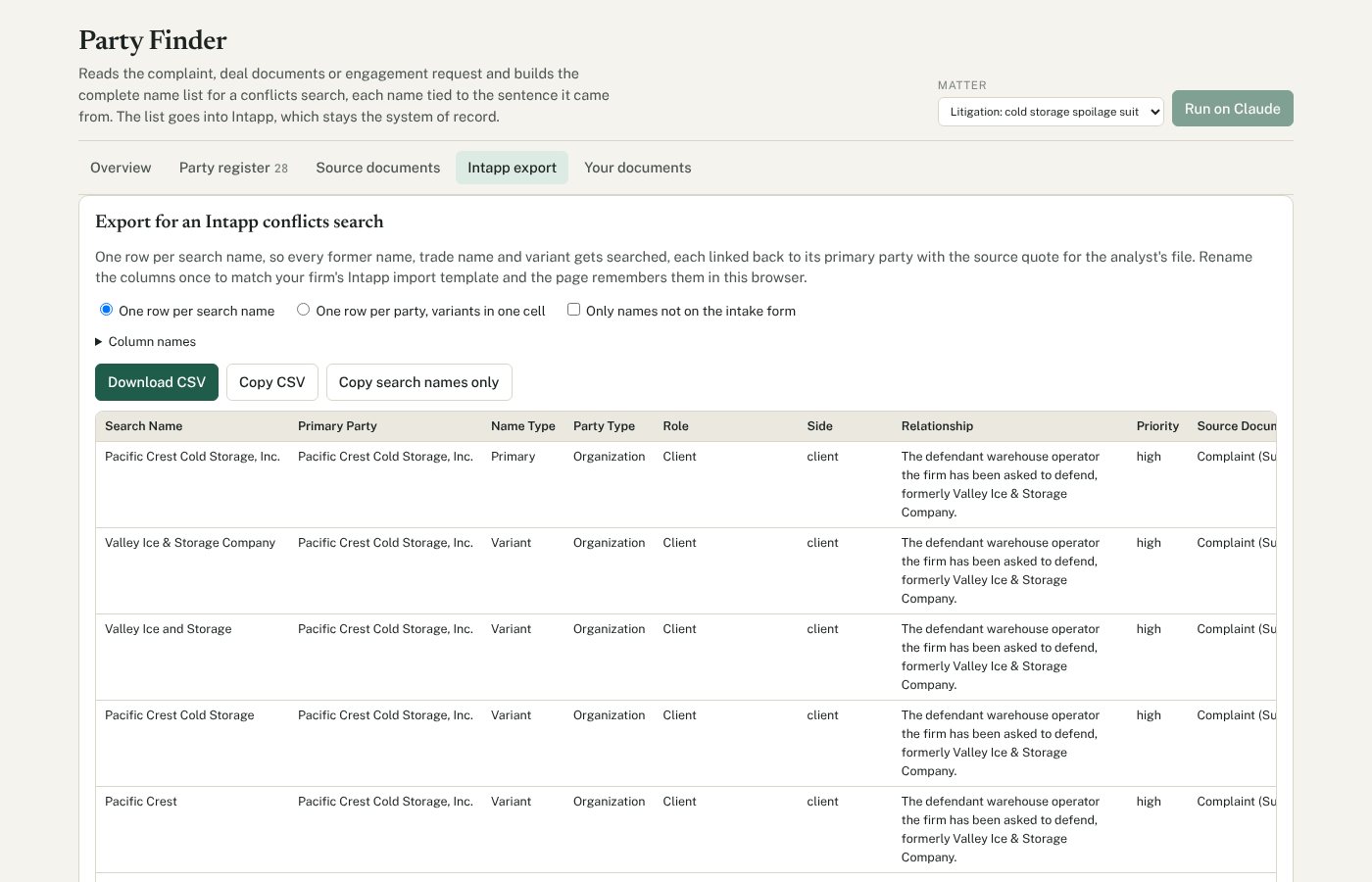
- Exports one row per search name for the firm’s conflicts system.
Decisions behind it
- Feeds the system, does not replace it. The conflicts system stays the system of record; this fills its input.
- Every name is traceable. A name with no verified quote does not make the list.
- An analyst decides. It never clears or declines a matter.
What the recorded run showed
The litigation matter produced 28 parties against 3 on the intake form, and an M&A deal produced 33 against 3. All 61 supporting quotes were found word for word in the documents.
Built with Claude Code as a page that calls Claude for the analysis. It grows out of the Conflion conflicts work.
Case study 18 · Practice workflows
Matter Desk
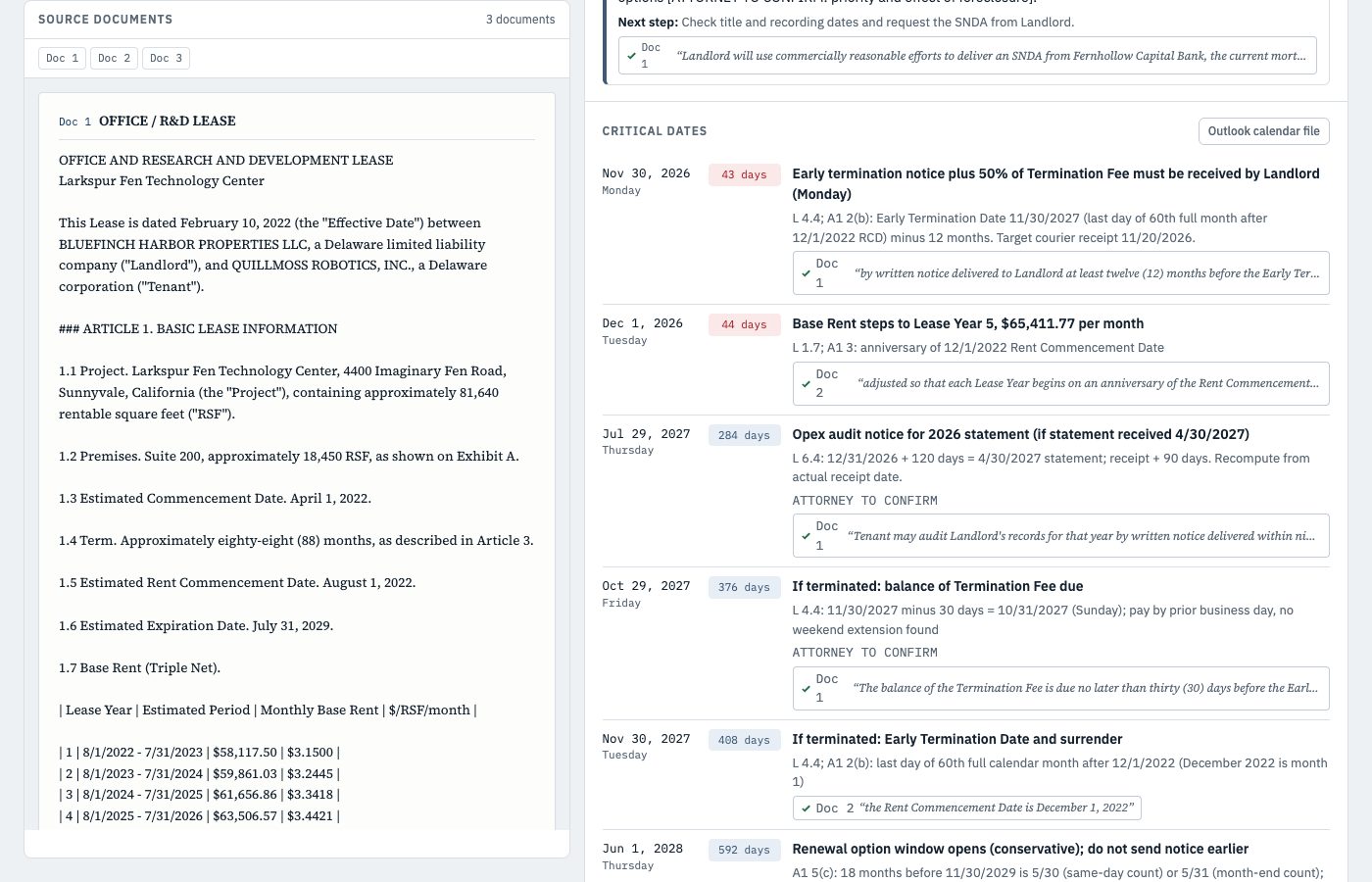
One desk for the first read of a new matter in five practice areas: M&A diligence, an insurance tender, a PAGA notice, a lease abstract and a health care BAA. It reads the documents, says what a rushed review would miss, dates every deadline and drafts the first letter or email, with every quote checked against the source.
Try the demoSaved runs on this site; live analysis runs inside Claude
The problem
The first read of a new matter is where things get missed: a consent buried in a customer contract, a notice period that has already run, an amendment that quietly moved a deadline. Each practice group has its own checklist, and a rushed reviewer works from memory.
What it does
- Five workflows, each driven by a written practice checklist: deal diligence, tender and coverage, PAGA notice intake, lease abstract and dates, and BAA review against a playbook.
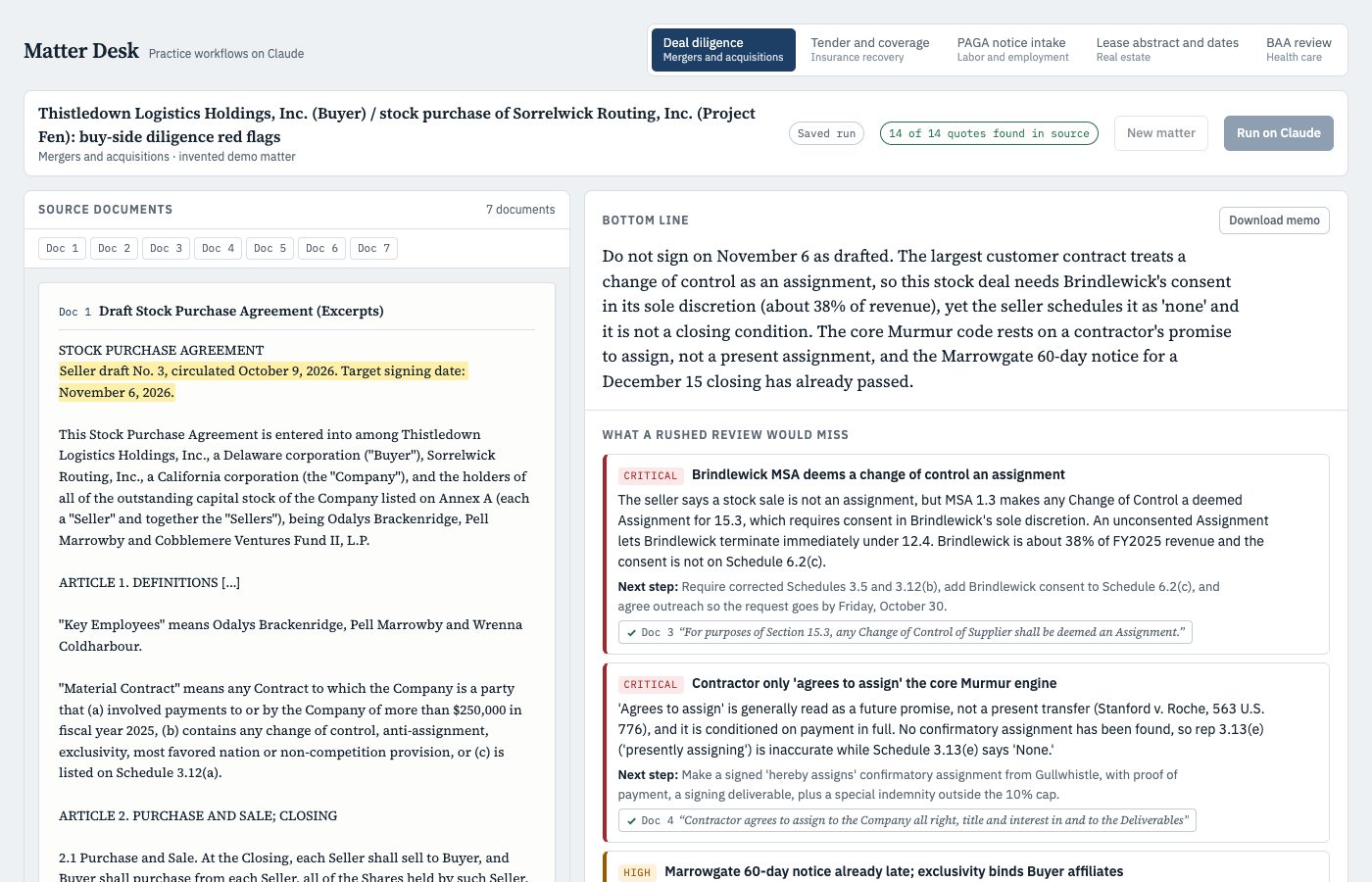
- Bottom line first, then the catches ranked critical, high or medium, each with a next step.
- Critical dates with the clause and the arithmetic behind each one.
- The working document for the practice: a consents tracker, a coverage chart, a PAGA issue table, a lease abstract or a clause-by-clause BAA comparison, plus a first draft such as a tender letter or litigation hold.
- What to ask the client for, and a sign-off checklist for the lawyer.
Decisions behind it
- Quotes are checked by code. Every quote is matched against the source text in the page, and one that cannot be found is flagged in red.
- Gaps are marked, not guessed. Open points are labeled for the attorney to confirm.
- A lawyer decides. Claude drafts; nothing is final until the sign-off checklist is worked through.
What the saved runs show
Each workflow opens on a saved run of a demo matter. Across the five, all 66 quotes were found in the source documents. In the deal workflow, it catches that the largest customer contract treats a change of control as an assignment needing consent, which the seller’s schedules list as needing none.
Built with Claude as a page that calls Claude for the analysis. Pasting in a new matter and asking questions of the documents work when the page is opened inside Claude.
Case study 19 · Deal workbench
Synthesis
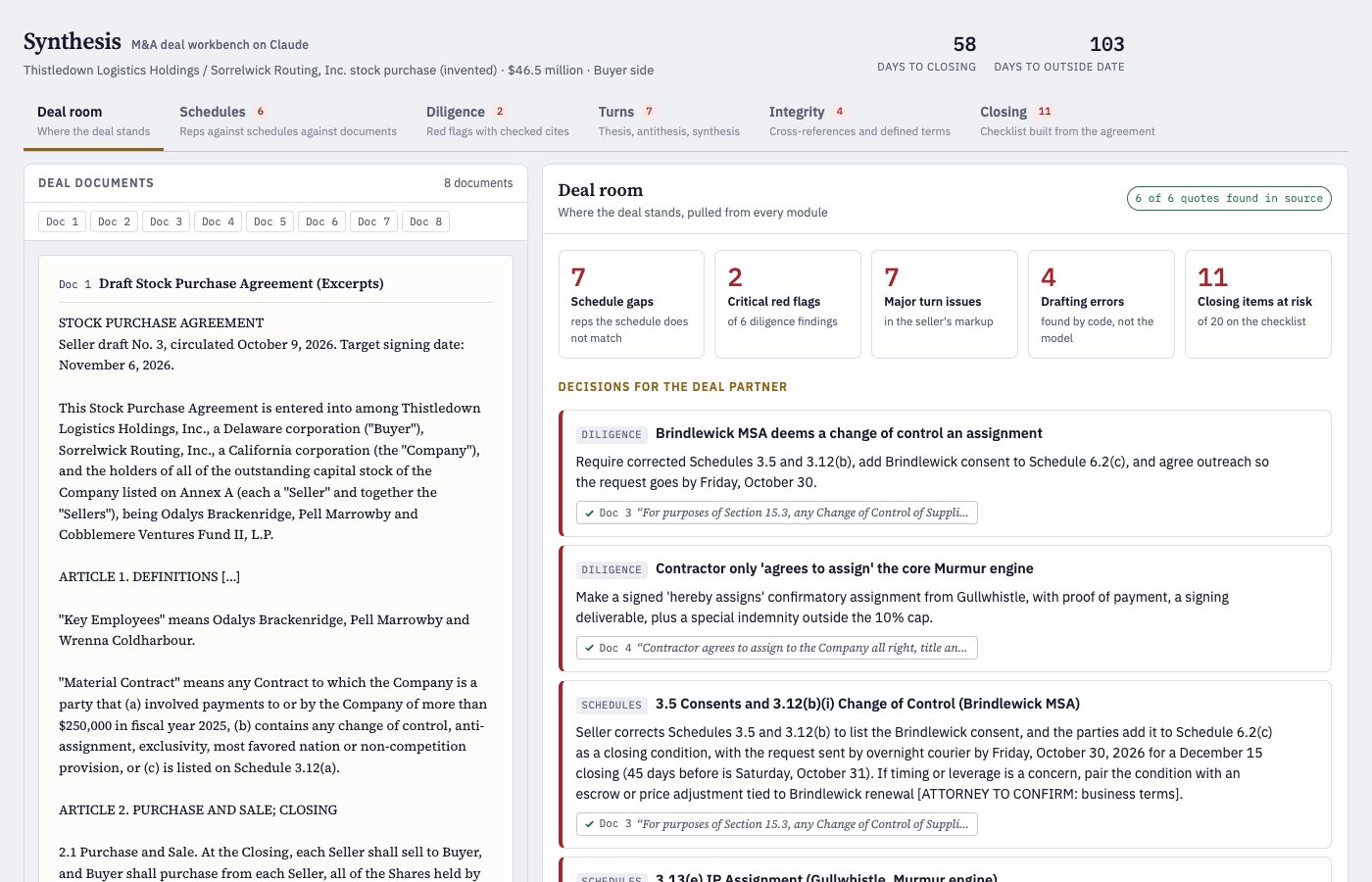
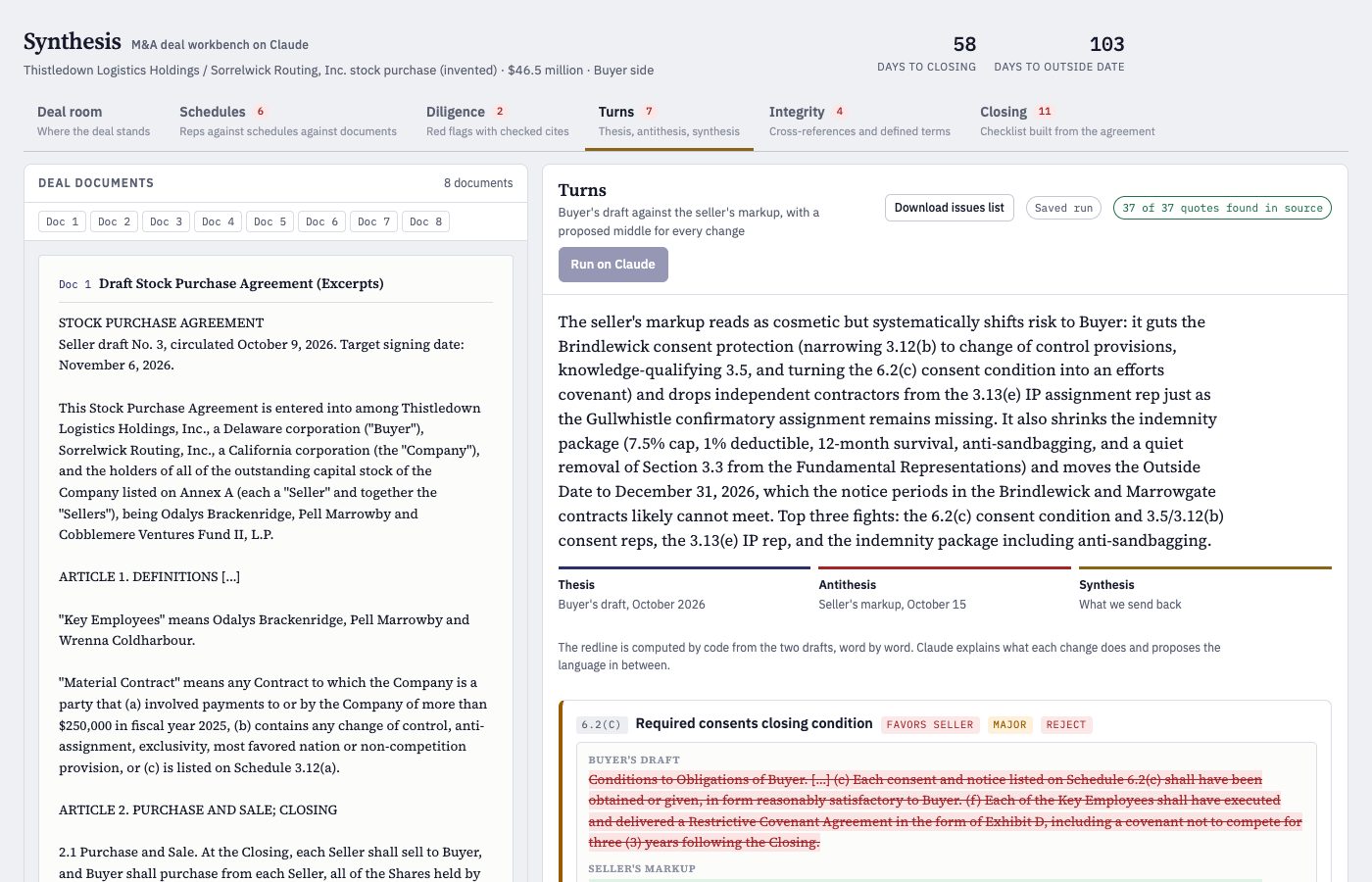
An M&A workbench for the buy side of one deal. It checks the seller’s disclosure schedules against the reps and the contracts, explains every change in the seller’s markup and proposes a middle position, checks cross-references and defined terms in code, and builds the closing checklist from the agreement.
Try the demoSaved runs on this site; live analysis runs inside Claude
The problem
Deal lawyers check the same things by hand against a deadline: whether the schedules match the reps and the contracts, what the other side’s markup quietly changed, whether cross-references still point anywhere, and what has to be signed at closing. Each is a separate pass, often done at the last minute.
What it does
- Deal room: decisions for the deal partner and the next dates, with days to closing and to the outside date.
- Schedules: each rep set against what the schedule says and what the documents show.
- Diligence: red flags, each with a checked citation.
- Turns: every change in the seller’s markup, who it favors, and a proposed middle position.
- Integrity and Closing: cross-reference and defined-term checks, and a checklist by phase with signature pages.
Decisions behind it
- Code does what code can. The redline, cross-references, defined terms and date arithmetic are computed in the page, not by the model.
- Quotes are checked word for word against the deal documents, and anything not found is flagged.
- Grounded in the work. The page cites what deal lawyers have said in public about each task.
What the saved runs show
On the demo deal, the saved runs find 7 reps the schedules don’t match, 7 major issues in the seller’s markup and 11 of 20 closing items at risk, and the code finds 4 drafting errors. All 37 quotes in the markup analysis were found word for word in the documents.
Built with Claude as a page that calls Claude for the analysis. It uses the same deal as Matter Desk’s diligence workflow.
Case study 20 · Litigation debrief
Case Wins Debrief
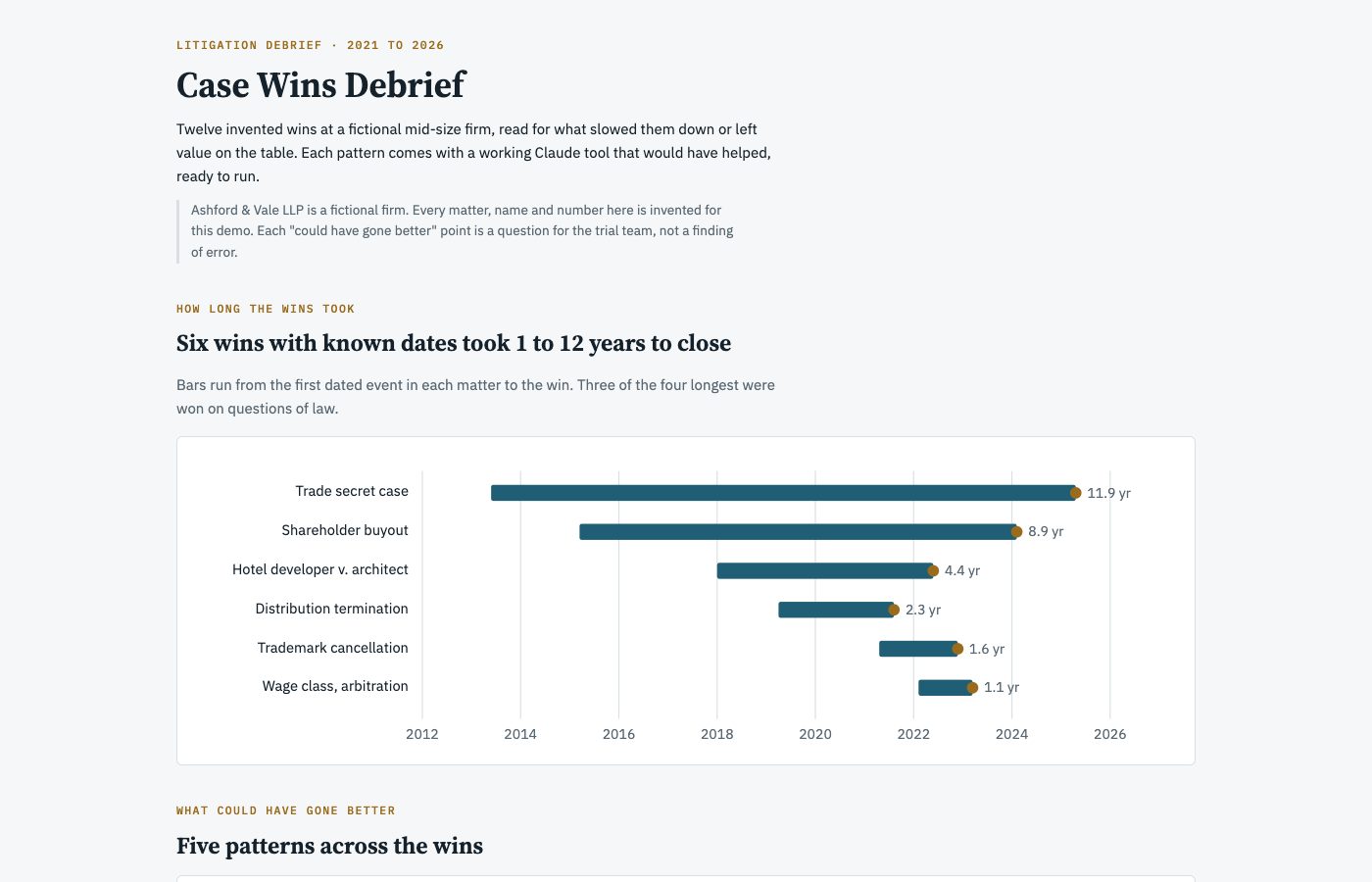
Reads a firm’s case wins for what slowed them down or left value on the table, groups the lessons into patterns, and pairs each pattern with a working Claude tool.
Case Wins Debrief
Reads a firm’s case wins for what slowed them down or left value on the table, groups the lessons into patterns, and pairs each pattern with a working Claude tool.
Try the demoSaved runs on this site; live analysis runs inside Claude
The problem
Firms announce a win and move on. The lessons in it, such as a legal question that waited years for a motion, a notice that nearly sank a claim, or a fee award never claimed, rarely get collected, so the next team repeats the delay.
What it does
- Times the wins from the first dated event to the result.
- Finds patterns across the wins, each tied to the matters behind it.
- Asks the trial team a question for every win, rather than passing judgment.
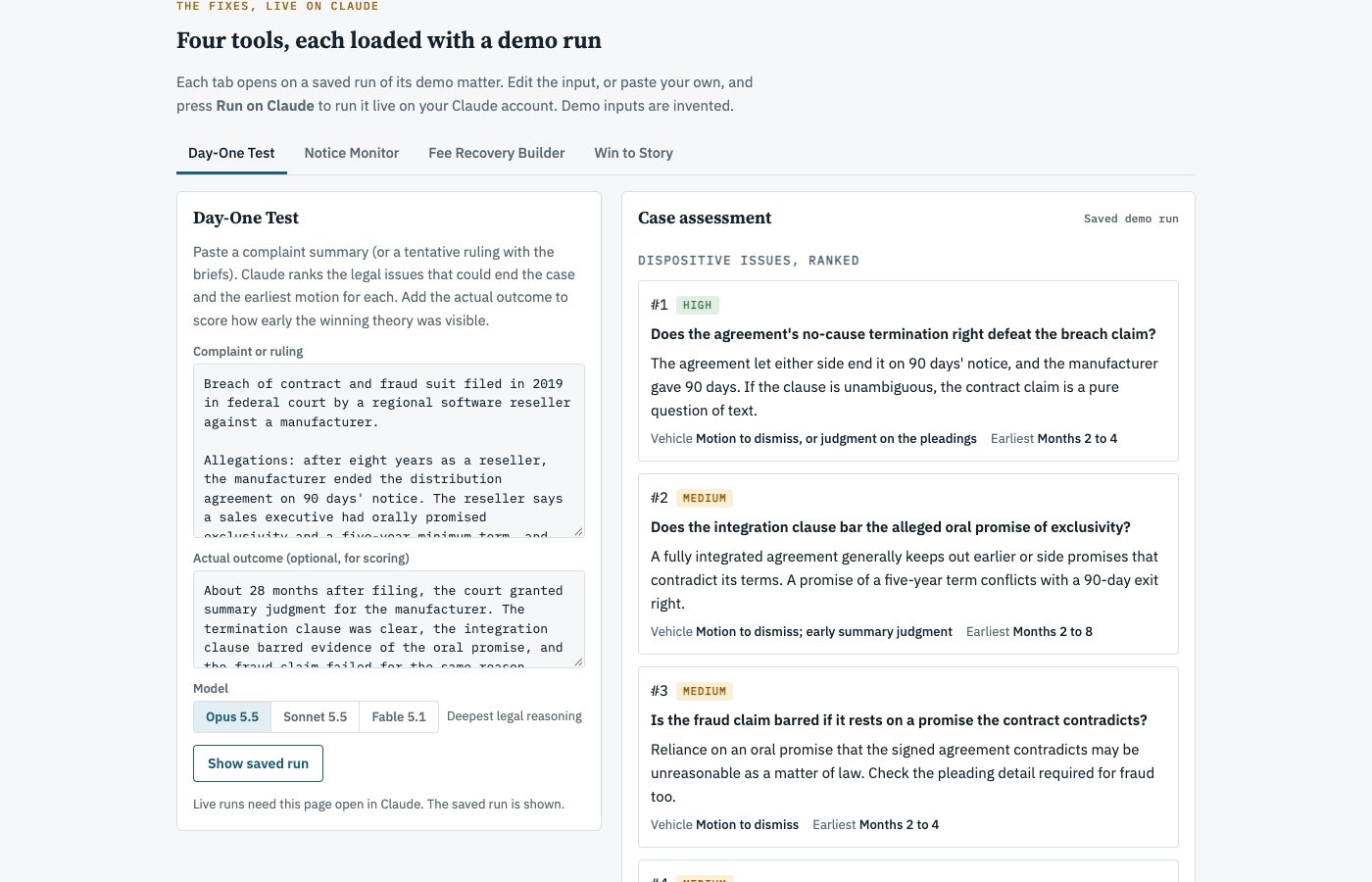
- Four tools, each with a saved run: Day-One Test ranks issues that could end a case early; Notice Monitor checks an event log against a contract’s notice clause; Fee Recovery Builder sorts time entries for a fee motion; Win to Story turns a ruling into a release, an alert angle and a matter-experience entry.
Decisions behind it
- Questions, not findings. Each "could have gone better" point is something to ask the team.
- Arithmetic stays in code. The fee tool totals the lodestar in the page.
- One tool per lesson. Every pattern ends with something a lawyer can run on the next matter.
What the demo shows
Twelve wins produce five patterns: cases won on law that took years, contract wins that turned on notice paperwork, fee-shifting wins that need a clean fee record, wins that came only after a setback, and wins nobody wrote up for clients.
Built with Claude as a page that calls Claude for each tool.
Case study 21 · Firm marketing
Marketing Studio
Drafts law-firm marketing in the firm’s voice: attorney bios, client alerts, RFP responses and award submissions. A second Claude pass then checks each draft against the source and California’s attorney advertising rules before anyone publishes it.
Marketing Studio
Drafts law-firm marketing in the firm’s voice: attorney bios, client alerts, RFP responses and award submissions. A second Claude pass then checks each draft against the source and California’s attorney advertising rules before anyone publishes it.
Open Marketing Studio in ClaudeHosted in Claude; example runs show first, and live drafting uses your own Claude account
The problem
Law-firm marketing is drafted from scattered notes and checked late. The risks are specific: a "specialist" or superlative claim the rules restrict, a client named without consent, a result with no disclaimer, or a fact nobody can source.
What it does
- Attorney bio: website, short and one-line bios, representative matters and website tags.
- Client alert: the alert with a source tag on every legal statement, a LinkedIn post and a subject line.
- RFP response: a requirements matrix, easy-to-miss items, win themes and a cover letter.
- Award submission: keeps confidential matters marked for the researcher only, with a referee template.
- Model picker and revisions: Opus, Sonnet or Fable, and a box to ask for a change.
Decisions behind it
- Only facts from the source. Anything missing becomes a marked placeholder, never an invented client, result or referee.
- The rules are written in. No superlatives, no assumed pronouns, clients named only with recorded consent.
- An attorney approves. Every draft is a starting point for the responsible attorney.
What the example runs show
Each workflow opens on an example run Claude generated with the same instructions. Across the four, the review raised 18 items: 3 to fix before publishing, 8 for the attorney to verify and 7 passed checks. One fix is four required RFP items with no content yet.
Built with Claude as a page hosted in Claude that calls Claude to draft and then to review.