Watch all 14 songs on YouTubeStart with one video
The song workflow
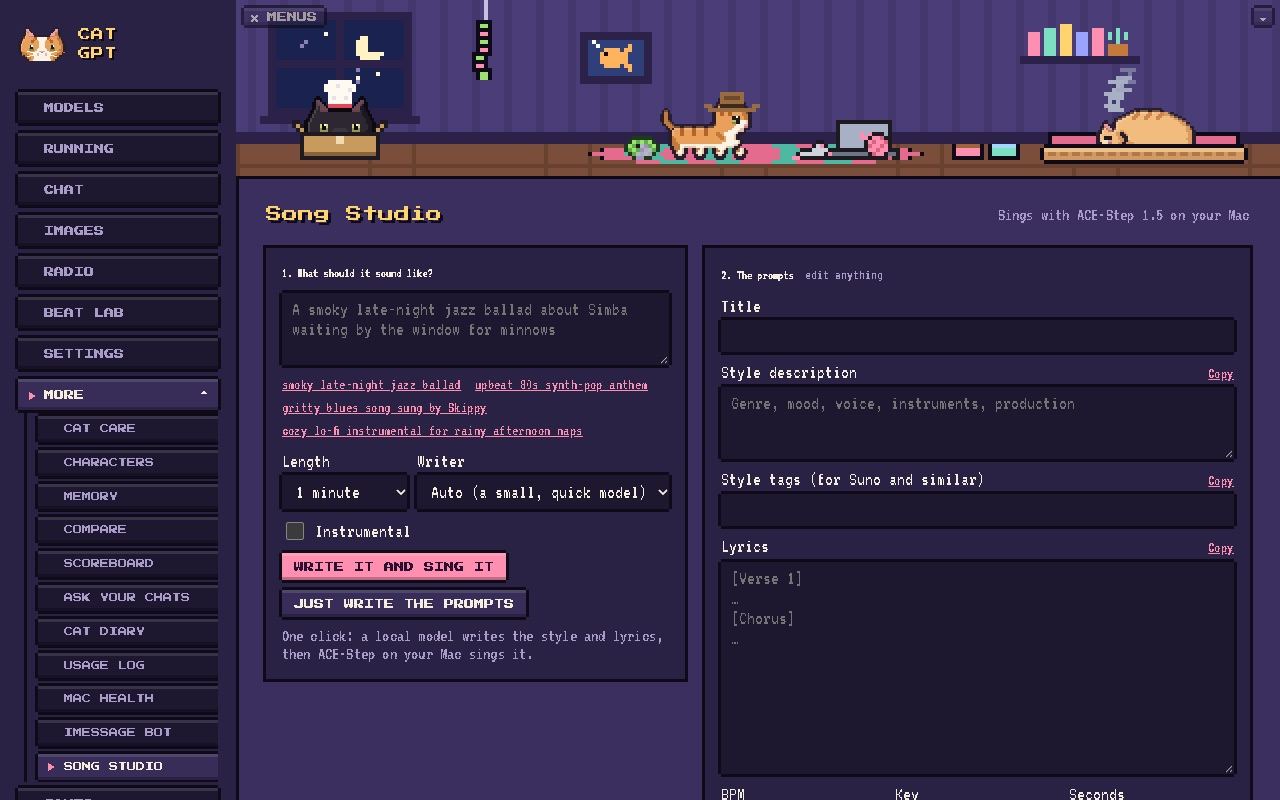
The songs are written with Suno, and the process is a written system: concept, style, structure, meter, hook, verses, then a rhyme audit and a length audit before anything is generated. After generating, the song is diagnosed before it is rewritten. The full workflow runs to 17 steps; these are the ideas that matter most.
Start with the premise
Name the core concept, point of view, emotional tone and the central joke or tension, and brainstorm scenes and images before any lyric. Comedy works best when the singer treats an absurd premise completely seriously. The joke is never explained; it comes out of the character's logic.
A separate style prompt
Genre, BPM, drum feel, bass, harmony, instruments, vocal register and timbre, texture, space and mood, in under about 1,000 characters. The instrumental should sound like a real record first: future garage, neo-soul, dub, dancehall, vintage calypso, synth-funk, jazz-funk. Funny lyrics don't need funny production, and the contrast is often what makes them funny.
Lock structure, then meter
Sections are decided before writing, and equivalent sections get equivalent line counts (8, 12 or 16, never a verse that runs long because it has more jokes). A syllable pattern is set per section, such as 8/8/8/8 or 7/10/7/10, with an even stricter meter in the chorus because the music model needs a predictable shape.
The hook is designed on its own
A short repeated phrase of three to five syllables with a repeated grammatical construction and simple words: "Kitty computer", "No teef, big life". The chorus gets its own identity instead of summarising the verses.
Verses are distinct scenes
Concrete images, physical detail and character-specific logic. When several characters sing, each has a different worldview, vocabulary and kind of joke, and no two are interchangeable.
Rhyme with rules
End, internal, multisyllabic and slant rhyme, with several rhyme points inside a line when it comes naturally. No word rhymed with itself, no lazy pseudo-rhymes such as side and outside, and no bent syntax to force a rhyme. Sound beats spelling.
Written to be sung
Where do the stresses fall, can the singer breathe, are the vowels good for held notes, and does each line have a rhythmic shape like its neighbour? A lyric can look clever on paper and still generate badly if the meter is unstable.
Realistic runtime, musical endings
The target is about 3:15 to 3:30. If a lyric is too long, cut the weaker jokes and shorten the bridge rather than rush the model. Endings are a refrain, a stripped hook, a harmony stack or an instrumental fade, not a spoken skit.
Arrangements that evolve
Dropouts, countermelodies, filtered passages, bass breaks, drum changes, vocal stacks, dub-delay throws, sparse bridges and a bigger final chorus, so the track develops instead of looping. Vocals are described precisely, for example a high, clear, intimate lead with airy falsetto edges, close-mic phrasing, whispered doubles and soft stacked harmonies.
Quality control before output
Fifteen checks run on every lyric: equal line counts in matching verses, the intended syllable pattern, a consistent chorus meter, a short memorable hook, no self-rhymes or lazy rhymes, internal and multisyllabic rhyme present, no line much denser than its neighbours, a lyric that scans out loud, distinct verses, a realistic runtime, a joke that is embodied rather than explained, a musical ending, and a production prompt that sounds like a real record. The output is always two copyable blocks, a style prompt and the lyrics, with no long explanations.
Diagnose before rewriting
- Confused melody: check syllable count and line length.
- Weak chorus: simplify it and repeat more.
- Rushed verses: cut density or cut lines.
- Feels childish: make the production more serious.
- Forced jokes: go back to character perspective and concrete detail.
- Weak rhymes: rewrite the rhyme structure instead of patching words.
Concept, style, structure, meter, hook, verses, rhyme audit, length audit, generate, diagnose, revise.
Cat Music Video Studio
A toolkit that connects a recorded song to a timed storyboard and animated character performances. Turning a finished song into a video means coordinating several timelines at once: the recording, the lyrics, the characters' performances and the visual story. Written lyrics don't capture how a singer actually delivers them, and repeated hooks, held vowels, pauses, ad-libs and changed pronunciations all make synchronisation hard. I directed the AI-assisted build of the tool that solves it.
An interactive review tool
One browser workspace holds the song, the isolated vocal, the lyrics and the storyboard. Words and lines are clickable to audition them, master and vocal switch without losing your place, and playback speed slows difficult phrases. A waveform seeks on click, the current word highlights live, and search and section filters move through verses and choruses. Review flags and confidence labels mark uncertain alignment, and a storyboard view ties timed scenes to actions, camera direction, continuity notes and generation prompts.
Audio analysis and alignment
Scripts decode the master and the isolated vocal, measure both, and compare sync at several points. Whisper recognition and reference-conditioned alignment propose word and line timings, and separate analysis of each stem gives evidence to compare them. Targeted passes handle the hard parts: repeated calls, short interjections and closing phrases. The data keeps supplied lyrics, model recognition, candidate timestamps and unresolved events apart, so uncertainty stays visible.
Production data other tools can use
JSON for timing maps, audio metadata, lyrics, scenes and review evidence. CSV for word and line timings, sections, non-lyric intervals, scene plans and review logs. SRT for draft captions. HTML for an interactive review package with the timing data embedded. Together they give audio, shots, captions and animation one shared timeline.
The songs
Fourteen songs so far, all starring my cats, written and generated with the workflow above and collected in one YouTube playlist.
- Why You Chase Me, Newty?
- On Mi Turf
- No Teef, Big Life
- Mommy Saved Mi
- Who Puke Pon di Floor?
- Vet Day Come
- Mi Nah Like Moving Day
- Every Lane, Every Road
- Free Di Claw
- Shoulda Leave di Treats Alone
- Please Turn on di Sink
- Flea Pon Me
- Kitty Computer
- Open up the Door
A finished animation
A complete music video built in the browser with p5.js, combining character drawings, environments, timed shots, captions and the original song. Mouth opening follows word timing and vocal amplitude, the mouth closes between timed words, and singing can be switched on or off per shot. Mouth and tongue shapes respond to the resulting value. It has play, seek, restart, mute, caption and fullscreen controls, plus a rendered vertical-video version.
- "Every Lane, Every Road": a 34-shot animated video, about 3 minutes 33 seconds, exported at 1080 × 1920 and 25 fps.
- "Why You Run Me Down, Newty?": 627 word records and 44 proposed shots.
- "Mommy Save Mi": 567 word records and 42 proposed shots.
Built with
Python, Whisper small.en, stable-ts, FFmpeg, NumPy, SciPy, soundfile, JavaScript, HTML and CSS, and p5.js.
My roleI set the creative goals, supplied the songs and characters, directed the AI-assisted build, and shaped the workflow through requirements and feedback. It was built through an iterative ChatGPT and Codex workflow, which wrote the implementation, analysis scripts, production documents and animation code.